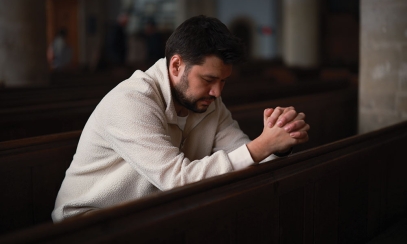

Why do I like religion?
That’s a curious question, isn’t it? Why do I like religion?
I can say why I like a lot of things in this life: sports, music, art, work or leisure. But why would I like religion? That is about as tough to answer as when asked, “Why do I like life?” Both are very broad topics, and ones we don’t expect to analyze.
That’s a curious question, isn’t it? Why do I like religion?
I can say why I like a lot of things in this life: sports, music, art, work or leisure. But why would I like religion? That is about as tough to answer as when asked, “Why do I like life?” Both are very broad topics, and ones we don’t expect to analyze.
Some might ask, “Why do I even need religion? I am a spiritual person and I can go it alone with God and onto eternity without a formal religion, without a community of other spiritual souls.”
However, even the most heroic soldier cannot win a war without an army (unless you’re King David). Similarly, the most saintly person cannot win the war of salvation without the companionship of fellow religious. The song is “Onward Christian Soldiers,” not “soldier.” But let’s not rush the answer; let’s build it.
Why do we like worldly things?
I submit that most of us like worldly things at which we succeed — be it making money, playing certain games, reading, singing, our profession or a hobby. Many years ago, two psychologists (Osipow and Schied) conducted a study in which they rigged the results so that subjects in the experiment succeeded at what they initially did not prefer. What do you think the subjects did after? They changed their preferences to things at which they succeeded.
Why do we like life?
Perhaps the same reasoning can be applied to life. We like life to the extent that we succeed at it, know how to play the game, know how to navigate and succeed in our society and culture. For many of us, we learn how to play the game of life better as we grow older, and we subsequently like and enjoy life all the more. Sadly, those who never “figure out” life run the risk of living their final days less satisfied and evaluating life less favorably in the end.
Why do I like religion?
Even with religion, the more successful you are, the more likely you might be to say you like religion. You might feel successful and, therefore, inclined to like religion all the more, whether you understand your religion better, as in a more cognitive religion like Catholicism; whether you feel your religion more emotionally, as an evangelical; or whether you behave your religion more fervently, like Mormon missionaries or Jehovah’s Witnesses, walking door to door.
For Christianity, it comes down to welcoming, if not necessarily liking, death. If you believe death has been defeated by the resurrection of Jesus, then why wouldn’t you like the idea of moving on to the more wonderful life Jesus has promised in eternity? Who wouldn’t be happy that their religion allows them not to worry about death anymore?
Our faith brings us the belief that death is not the end. Our bodies will be glorified in the same way Jesus’ resurrected body was. We won’t have our imperfect earthly forms that are limited by the circumstances dealt at birth or through life circumstances. Rather, we will have the perfected versions of our earthly bodies.
How can I be assured of eternal life?
The answer is because Jesus said he is the way, the truth and the life. He taught “that everyone who believes in him might not perish but might have eternal life” (Jn 3:16). As devout Catholics, we believe and follow the things Jesus said. So why would we not believe this proclamation of utmost importance, one that says that we are not going to be gone forever and blink out of existence?
In his book “The Courage to Be,” Paul Tillich suggests that the fear of death is the basis for all other fears. But, now we don’t have to worry about death anymore, because “Jesus said so!”
One conclusion might be to cling less to this life. We should embrace death as the doorway to an eternity that we will enjoy much more than this present existence. Let’s practice our religion, this beautiful gift of universal faith, fervently as the path to that doorway.
And that is why I like religion: I like having a pathway to eternal life with Christ Jesus.
Thomas Dorsel, Ph.D., is professor emeritus of psychology and a graduate of the University of Notre Dame. He lives on Hilton Head Island with his wife Sue and is a parishioner at St. Francis by the Sea Church. Visit him at dorsel.com.