The lament of Jesus
Do you know the historical reasons why Jesus was condemned to death? If we read carefully, we see throughout the Gospels that Jesus became a thorn in the side of and a scandal for the Pharisees, and even for the Romans, which began a progressive and increasing rejection of him. It is, at its heart, a rejection of God’s love that is personified in Christ and revealed in his miraculous deeds like healings and the expulsion of demons and exorcisms.
Do you know the historical reasons why Jesus was condemned to death? If we read carefully, we see throughout the Gospels that Jesus became a thorn in the side of and a scandal for the Pharisees, and even for the Romans, which began a progressive and increasing rejection of him. It is, at its heart, a rejection of God’s love that is personified in Christ and revealed in his miraculous deeds like healings and the expulsion of demons and exorcisms.
It was also revealed in smaller, less obvious ways like allowing himself to be accompanied by sinners. Authorities frowned on this because it was understood that a man of God should not associate with those who transgressed the Law. Furthermore, Jesus’ interpretations of Scripture were contrary to the way the Pharisees interpreted it. An example was Christ’s teaching on legal purity when he said that what defiles a person isn’t what goes into the mouth but what comes out of the heart. Jesus’ actions generated doubts regarding the authority with which he exercised his ministry; it was even supposed that he was casting out Satan with the power of Satan himself.
At the time of Jesus’ trial, there was already a widespread climate of misinterpretation, rejection and misunderstanding of the prophetic signs he performed. Jesus’ trial was a double procedure: the Jewish authorities, who were responsible for the religious process, handed him over to the Roman authorities, who were responsible for the civil process. The accusations were different depending on the authority. Since Pontius Pilate had to be given arguments of a civil nature, they accused Jesus by saying that he called himself a king; this is why “Jesus of Nazareth, King of the Jews” was written on his cross with the initials we know today as INRI. However, it was the religious accusations that determined Christ’s condemnation. Even Pilate washed his hands of this judgment because he saw no civil crime in him. The three main accusations were:
For acting against the Law: the Pharisees maintained that if Christ was truly a man of God, he had to obey the Law as they interpreted it. Another example: the act of healing on the Sabbath was considered a transgression and disrespect for the precepts, but when Christ responded that the Sabbath exists to serve man and not the other way around, he highlighted what the Pharisees had lost sight of — that for God, the person is always more important than the Law.
By questioning the centrality of the Temple of Jerusalem: the teachers of the Law interpreted Jesus’ attitudes and actions as an insult to the Temple, specifically when he drove out the money changers. Far from being an insult, Jesus’ holy anger cleansed the Temple and was a wake-up call to end the desecration that they were allowing in the Father’s house.
The manifestation of Jesus’ divine identity: when Christ revealed his intimacy with the Father by calling himself “Son of God,” it became clear that he and the Father were (and are) one. This fact caused a scandal in the monotheistic conception of Judaism and was interpreted as a contradiction to that faith. It was then that religious authorities branded him a blasphemer for equating himself with God.
Jesus’ surrender was even a scandal. Though he prepared his disciples for the moment — announcing it to them beforehand to prepare their hearts for what they were to witness — they still misunderstood exactly how he would suffer and what it would mean for their faith. When Jesus entered Jerusalem, he did so knowing what was going to happen. His entry was simultaneously glorious and dramatic, a mystery of acceptance and rejection of his person.
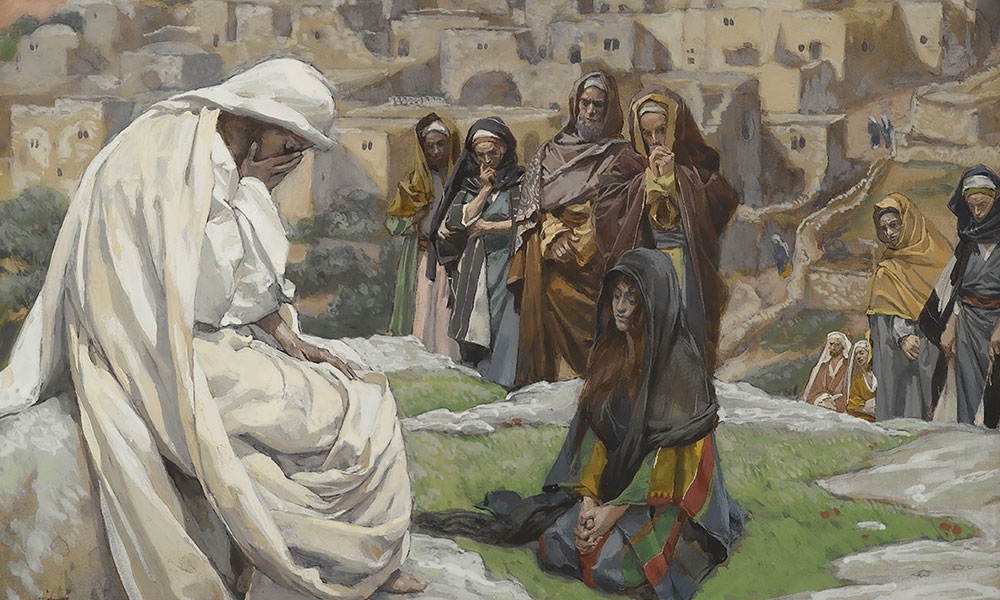
It was at that moment Jesus lamented, “Jerusalem, Jerusalem, you who kill the prophets and stone those sent to you, how many times I yearned to gather your children together, as a hen gathers her young under her wings, but you were unwilling” (Mt 23:37). And Jesus wept because he contemplated his people’s rejection of his arrival; he wept for their repudiation of grace.
Jesus entered the city riding a donkey, which did not reflect poverty, but a peaceful, humble and gentle royalty. In contrast, a horse would have reflected a violent kind of royalty, a symbol of war. The donkey demonstrated that Christ’s way of reigning is peaceful, and he still seeks to touch the hearts of men, calling for mercy and conversion. On seeing him, some said, “Hosanna,” and “blessed is he who comes in the name of the Lord” (Mt 21:9). Those with childlike hearts who welcomed Jesus with songs, laying cloaks on the ground and waving palm branches represent the Israel that is ready to receive their Messiah. However, others were seeking him out to condemn him. These happened simultaneously.
The Church begins Holy Week with Jesus’ entry into the great city. It is a moment that combines joy and sorrow, happiness and tragedy, because Christ came to his own, and his own did not receive him. This rejection or acceptance also occurs within each of us, for we are given the opportunity to embrace grace or reject it. Jesus’ entry into Jerusalem calls on us to rediscover our first love and to welcome Jesus as those innocent hearts did, shouting “Hosanna!”
May our hearts, far from judgment and condemnation, open their doors to Christ in such a way that he does not lament us, but rejoices because we receive him as the Messiah who came to save us.
Cristina Umaña Sullivan is a cultural sociologist dedicated to evangelization, with a specialty in Theology of the Body and identity creation from a Christian perspective. Email her at fitnessemotional@gmail.com.