
The paradox of Jesus' baptism
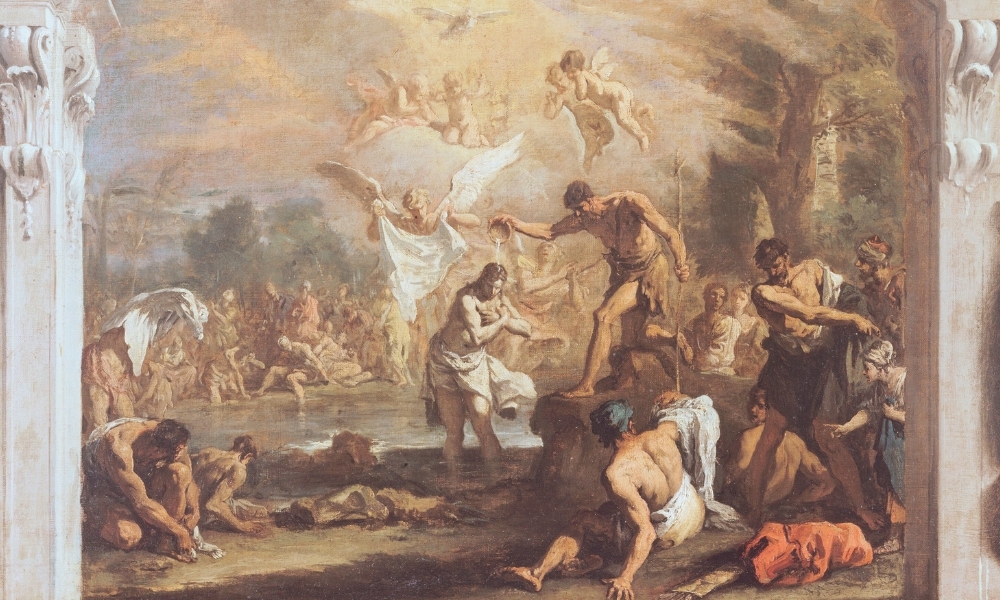
When John the Baptist was carrying out his mission as the last prophet, he began to attract attention and convince many people with his message and lifestyle. He warned that the Messiah was near and proclaimed a baptism of conversion for the forgiveness of sins.
When John the Baptist was carrying out his mission as the last prophet, he began to attract attention and convince many people with his message and lifestyle. He warned that the Messiah was near and proclaimed a baptism of conversion for the forgiveness of sins.
However, the most interesting aspect of the scene at the Jordan River was not the crowd that was present, but the fact that amidst a general baptism for those who considered themselves sinners, Jesus participated, blending in among them and allowing himself to be baptized as well.
This is both a surprise and an enigma: why did Christ allow himself to be baptized, instead of being the one to baptize?
It echoes the scene in which Jesus girds himself and kneels to wash the feet of his disciples before the Last Supper, performing the act of a servant who washed the feet of his masters. Peter tries to prevent Jesus from washing his feet, so Jesus explains that now is not the time to understand what is happening.
The same thing occurs with John the Baptist, who was also perplexed to realize that he was the one who should be baptized by Christ. In this case, Jesus allowing himself to be baptized reveals a great mystery: that he came to assume our faults because he is the only one who can transform sin into grace.
In the Old Testament, the High Priest would symbolically place the community's sins on the head of a goat; then the animal was abandoned in the desert, as the "scapegoat" of Israel because it assumed the sins of the people. It was part of the Day of Atonement (Yom Kippur), when this offering was made to cleans and remove all sin. These images prefigure the salvific task of Christ, the innocent lamb who assumes sins for the redemption of the people.
Although there was no sin in him, Jesus accepts to be counted among sinners and receives from John the baptism of conversion, thus inaugurating his public life. More importantly, it anticipated the baptism he would receive with his death.
Another important detail is that the grace of the sacraments begins with Christ. It was not the water that cleansed Jesus' sins, he had none; rather Christ, the Son of God, bestowed on the water the power to purify and cleanse sins during the sacrament of baptism.
We know that a rotten apple can spoil the rest of the apples in a basket. Here, the opposite occurs: the innocent one becomes one with sinners, and by allowing himself to be baptized, opens the doors of purification for us. Furthermore, the immersion in the Jordan River is a prefiguration of another immersion: Jesus is immersed into hell and emerges victorious through his resurrection; our sins are forgiven. It is a key moment in which Jesus' vocation is revealed. He takes on the sin of the world to win the battle against death and restores to us the grace we had lost.
At the same time, a theophany — or the manifestation of God's appearance to man — takes place as the voice of the Father says, "This is my beloved Son, with whom I am well pleased" (Mt 3:17). He who is mingled among sinners is the one beloved by the Father, and at that moment the Spirit becomes visible, descending upon the Son.
This theophany (from Greek theos "God" and phainein "to show") is also fulfilled in us: through our baptism, we become beloved children of the Father, and the Holy Spirit finds a dwelling place within us.
By beginning his public life with his baptism in the Jordan, Jesus reminds us of the beginning of the life of grace that we received during our own baptism. Let us embrace our identity as beloved children of the Father and temples of the Holy Spirit, following the example of our Lord.
Let us renew our baptismal promises so that we may be bearers of grace and transform our world, which is thirsty for forgiveness and resurrection.
Cristina Umaña Sullivan is a cultural sociologist dedicated to evangelization with a specialty in Theology of the Body and identity creation from a Christian perspective. Email her at fitnessemotional@gmail.com.