Soul cakes were Medieval treats long before tricks
A soul! A soul! A soul cake!
Please, good Missus, a soul cake.
An apple, a pear, a plum, a cherry,
Any good thing to make us all merry:
One for Peter; two for Paul;
Three for Him who made us all.
(Traditional English folk song)
A soul! A soul! A soul cake!
Please, good Missus, a soul cake.
An apple, a pear, a plum, a cherry,
Any good thing to make us all merry:
One for Peter; two for Paul;
Three for Him who made us all.
(Traditional English folk song)
Devotees of the gentle folksingers Peter, Paul and Mary will recall these lyrics but may not be aware of the story behind the song, a tale extending far into those medieval centuries which used to be called the Ages of Faith when belief in God permeated daily life.
Hallowtide is an ancient and honorable tradition and remains part of the liturgical year. In medieval Europe, on the evening of the vigil of the feast of All Saints — All Hallows Evening or Even — children in cities, towns, villages and hamlets went “asouling” or “asoalin,” as the word is sometimes rendered. They strolled door-to-door, offering householders their prayers for family members who may be in Purgatory.
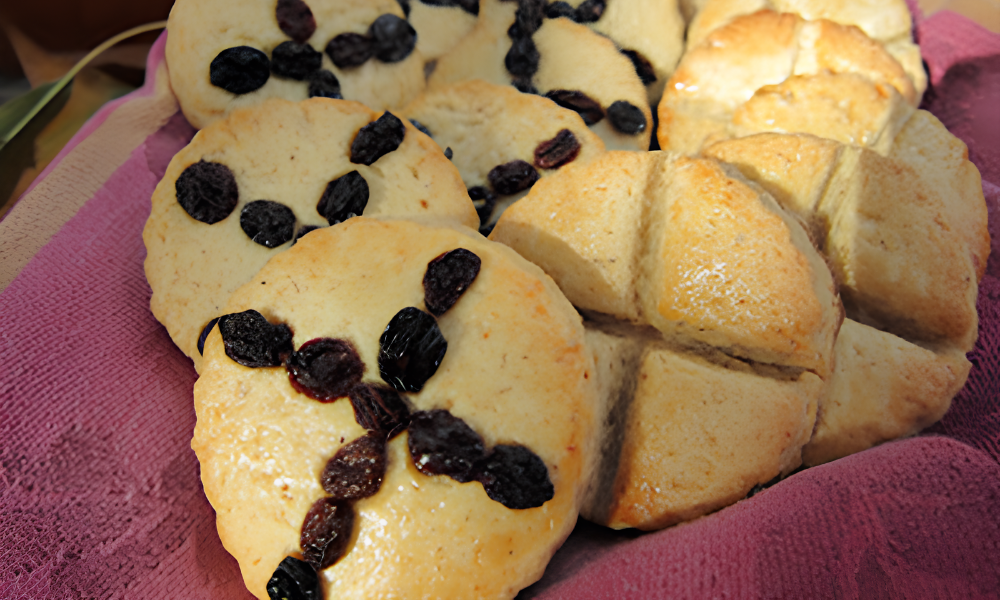
After those prayers were recited, grateful housewives presented the youngsters with small, round loaves of sweet quick breads or small cakes looking like muffins, or thick cookies, made with raisins or currants, each marked with a cross. They were best when eaten warm.
Yes, now is the time to present soul cakes, always marked by a cross, as a family’s humble, sacramental reminder of the Holy Eucharist and the joy of the wondrous, heavenly Supper of the Lamb.
This is the origin of the Hallowe’en (“Hallows Even”) tradition of “Trick or Treat.” The trickery wasn’t part of the original tradition but the “treatery” was.
My belief is that the trickery was taken, several centuries later, from the anti-Catholic Guy Fawkes Night and its rowdy celebration. Children begging for pennies carried effigies of the pope to be later burnt in a bonfire. They spent their money on bangers (sausages), sweetbreads and other comestibles sold by enterprising peddlers.
The tradition came to the American colonies with the mockery of Pope Night. However, impressed by the courage and loyalty of the Catholic members of his army, Gen. George Washington absolutely forbade any celebration of Pope Night among his troops, and the custom died out on these shores.
Two soul cake recipes follow — one sweet (sidebar), the other savory (below) — along with formulas for mulled apple cider and mulled ale to serve members of your “souling” party this coming Hallowe’en.
WATCH: And for fans of Peter, Paul & Mary, watch A’Soalin’ here: youtube.com/watch?v=vG3MZVZrM9A. The song was originally a autumntide carol written for Guy Fawkes Day (Nov. 5), but the group added the first stanza of “Tidings of Comfort and Joy” to give the song a Christmas flavor.
And a happy, hearty, blessed and Catholic Hallowe’en to us all!
French Ham & Cheese Soul Cakes
- 2 1/2 cups all-purpose flour
- 2 1/4 teaspoons baking powder
- 1/2 teaspoon fine salt
- 1/4 teaspoon baking soda
- 1/4 teaspoon freshly ground black pepper
- 1 1/4 cups shredded Gruyère cheese (about 3 1/2 ounces)
- 1 1/4 cups cooked ham, small-diced (about 7 ounces)
- 1/3 cup pitted Niçoise olives, similarly small-dice (about 1 1/4 ounces) (Keep several more olives in reserve to quarter for the tops)
- 2 large eggs
- 3/4 cup whole milk
This savory soul cake recipe is adapted from a quick bread loaf recipe. The soul cakes will have an extra punch of flavor from the briny Niçoise olives. In France, similar rustic quickbreads called gâteaux are served as snacks.
Place a rack in the middle of the oven and preheat to 350°F.
Whisk flour, baking powder, salt, baking soda, and pepper together in a large bowl until aerated and any large lumps are broken up. Add the cheese, ham, and olives and toss in the flour mixture until the pieces are separated and evenly coated; set aside.
In a medium bowl, whisk eggs, milk, and melted-butter until smooth. Add this to the flour mixture and stir until the flour is just incorporated, being careful not to over mix. It is just fine if a few streaks of flour are present; the batter will be quite thick.
With a rubber spatula, scrape the batter into a standard 12-well muffin pan. Be sure to coat the wells generously with butter first. Smooth the batter and press quartered olives into the tops in the shape of a cross. Bake for 20 to 25 minutes, until a toothpick inserted into the center comes out clean (test several spots since you may hit a pocket of cheese). Let cool for 10 minutes before attempting to remove the cakes from the pan. If desired, you may let them finish cooling on a wire rack.
Ale & Cider
All Saints Day Mulled Apple Cider
This warm fruity drink is a wonderful addition for Hallowe’en or All Saints' Day celebrations. This recipe yields eight servings.
- Half-gallon apple cider
- 2 tsp. orange zest
- 3 cinnamon sticks
- 3 whole cloves
- 1/8 tsp. ground allspice
- 1/2 cup fresh cranberries
Mix ingredients in large saucepan. Barely bring to a simmer over lowest heat setting. Do not allow cider to boil. Cook for twenty minutes. Strain spices and berries from cider by pouring through mesh sleeve/cheesecloth. Serve hot.
Mrs. Beeton’s Mulled Ale for All Souls Day
The best of British households subscribed to Beeton’s Magazine in the 19th century. Beeton’s Christmas Annual for 1887 introduced Sherlock Holmes to the world with “A Study in Scarlet”, and Mrs. Beeton’s Cookery Book and Household Guide has been a staple in British kitchens for over a century and a half. It was also one of the sources used by the late John Farrell and myself for our Sherlock Holmes Cookbook (Drake / Crown 1976).
- 1.25 liters good ale (about 3 pints; Guinness preferred, but Bass is good, too)
- 1 tbsp caster sugar (powdered sugar)
- 1/2 tsp whole cloves
- 60 ml rum or brandy (approximately 2 shots)
- freshly grated nutmeg, to taste
Heat the ale in a large saucepan with sugar and cloves. Don't allow it to boil.
Warm a jug by rinsing it out with boiling water, then pour the hot ale into the jug, adding rum or brandy and grated nutmeg to taste. (3 servings).
Sean M. Wright, MA, award-winning journalist, Emmy nominee and master catechist for the Archdiocese of Los Angeles, is a parishioner at Our Lady of Perpetual Help Church in Santa Clarita, California. Email him at locksley69@aol.com.
Medieval Souling Cakes
• 1½ cup plain flour (sifted)
• ¾ cup sugar
• 1 ½ cubes of butter (diced, then allowed to soften)
• 1/2 tsp ground cinnamon
• 1/2 tsp ground mixed spice
• 1/2 tsp ground nutmeg
• 1 egg (beaten)
• 2 tsp of white wine vinegar
• ½ cup raisins or currants
Instructions
Preheat oven to 400 F; grease 2 flat cookie sheets: set aside.
In a mixing bowl thoroughly whisk the sifted flour, spices, and sugar. Rub in the diced butter until the mixture resembles fine breadcrumbs. To this, add the beaten egg and vinegar then mix with a wooden spoon until a firm dough is made. Cover bowl with a towel and place it in the refrigerator for at least 20 minutes.
Flour a working surface and roll out the dough to about ¼ inch thick. With a circular pastry cutter (or, in a pinch, the lid from a mayonnaise jar) cut dough into rounds. Place these rounds on the greased cookie sheets. With the spoon’s handle or with a knife, press or incise a cross shape into the top of each round. Press the raisins or currants into the groove of the cross or press them into the quadrants between the lines as desired.
Bake at 400 F until slightly colored. Check after 15 minutes. If they’re not quite done leave them for another 3-5 minutes. This recipe makes 14 soul cakes, best when served warm but they’re also just fine after cooling.