Two Isidores — and a third
She planted, pruned, tended vegetable and flower gardens, picked grapes and apples, frequented a small greenhouse and often drove a truck full of rakes, hoes, shovels, bushel baskets and homemade concoctions that served as natural pesticides. Every afternoon, from 3 p.m.-4 p.m., Sister Isidore made a Holy Hour. There were moments of vocal prayer and hymns amid long, silent interludes. During those quiet times, she inevitably drooped a bit, leaned to the left and fell sound asleep.
She planted, pruned, tended vegetable and flower gardens, picked grapes and apples, frequented a small greenhouse and often drove a truck full of rakes, hoes, shovels, bushel baskets and homemade concoctions that served as natural pesticides. Every afternoon, from 3 p.m.-4 p.m., Sister Isidore made a Holy Hour. There were moments of vocal prayer and hymns amid long, silent interludes. During those quiet times, she inevitably drooped a bit, leaned to the left and fell sound asleep.
Sister Isidore was one of two sisters in my religious community who spent the entirety of their adult lives farming. Our motherhouse in Pennsylvania occupies roughly 300 acres — an 1870s mansion surrounded by multi-purpose outbuildings, including a barn that once housed horses and a large sleigh.
Across the front of the property are gazebos set among grassy hills the original owners used as a golf course in the era of hoop skirts. We sisters later built an academy, a gym, a chapel that became a minor basilica on its 50th anniversary and an extensive elder care facility. Some of the property has remained agricultural, some is still forested and wild. Sister Isidore was invested in the floral and agricultural part of it.
She came from a family of Slovak immigrants and grew up on the family farm, the eldest of many children. Devotion to the things of God and religious traditions were part of her upbringing. Eventually, she found her way to our community of sisters, who had a presence in several locations in her Connecticut home from early in the 20th century.
Our founder was a priest from Slovakia, and a number of women of Slovak origin were attracted to our group. Most of our sisters have been teachers, nurses or pastoral workers, but we have always included sisters in supportive services — like Sister Isidore — to “cultivate and care for” the garden, as Genesis 2:15 describes one of the charges given the first humans.
Because it is May, I tend to think of Sister Isidore. Always soft-spoken, good-humored and hard-working, she was one of those much-missed, unassuming personalities who, on May 9, 2017, left the lush outdoors and went home to God. On May 15, we always celebrate her feast day, her religious name day. Her patron saint was St. Isidore the Farmer.
Isidore the Farmer was a Spanish peasant who began working on the estate of a nobleman as a child. He spent his whole life, in the late 11th and early 12th centuries, on that estate outside Madrid. He married and had one child, who sadly died very young.
A quiet, dutiful man, Isidore was known for his great attention to the poor. He somehow managed to provide extra food from the crops and herds he tended and from his own table. He was particular about the humane treatment of animals and tended the land with great care. Both he and his wife Maria were noted for their devout attendance at daily Masses, their prayer and their reverence for God. They lived a life of joy, despite the tragic death of their child, because of their trust in God’s loving will and their hope for heaven.
Isidore’s was a reality-based piety, informed by a sense of God acting in everyday life. Devotion began shortly after his death, as miracles began to be attributed to his intercessory prayer. Today, he is revered as the patron saint of farmers and, in our country, as the patron saint of the Catholic Rural Life organization.
There’s another Isidore, though. While our Sister Isidore was named for the farmer, there is an earlier St. Isidore — a Spaniard of the sixth century, a nobleman who became a renowned teacher and promoter of scholarship. As archbishop of Seville, Isidore authored one of the first medieval encyclopedias and was honored as a brilliant “polymath,” a Renaissance man before there was a Renaissance. Along with Augustine, Catherine of Siena, Aquinas and Teresa of Avila, he is numbered among the doctors of the Church. The parents of Isidore the Farmer admired Isidore the Teacher as a national hero.
It’s a funny thing about saints. There is no class system in the eyes of God, and the most brilliant scholar of an age can stand shoulder to shoulder with a man who has dirt under his fingernails and a rough handshake. Sister Isidore was immensely patient and uncomplaining, even when her feet hurt and her arms ached. Like her patron the farmer, she lived close to the world of nature and close to God in a continuum of respect and love.
Sister Isidore left a lasting impression on more people than she might ever have guessed: sisters young and old, people who came to pick apples or purchase homemade cider, the maintenance crew who watched her climb ladders to prune branches, children and parents who encountered her winsome smile and gentle presence in those Saturday morning catechism classes.
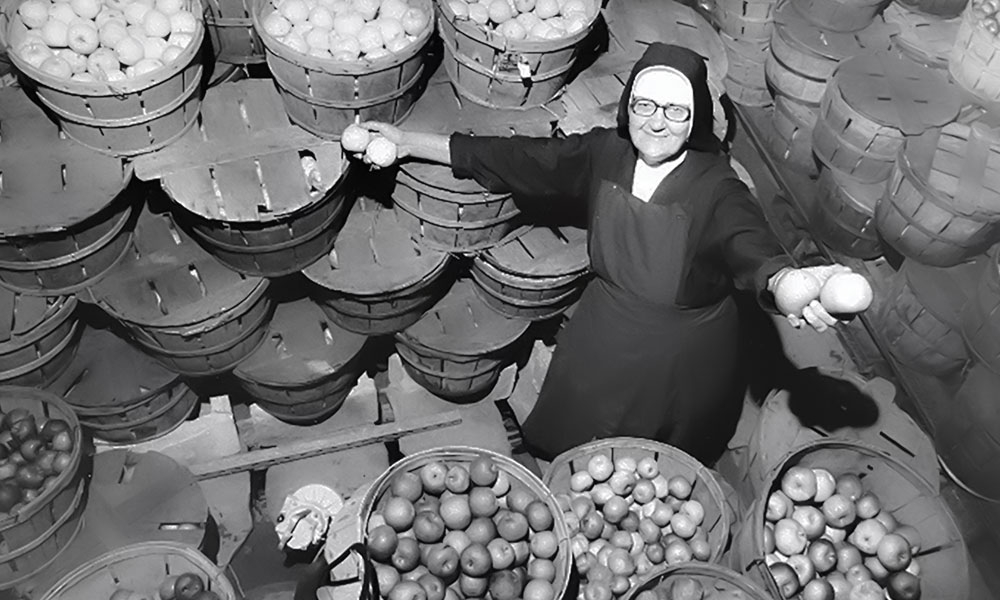
One lasting photo shows her grinning over a bushel of apples. Another image has her in the traditional long habit, with breezes blowing the dust of fields and remnants of seedpods onto her layered black skirts.
As I remember Sister Isidore and her patron saint this May, I am sure that she was wafted by the gifts of the Spirit and dusted in grace.
Sister Pamela Smith, SSCM, Ph.D., is the diocesan director of Ecumenical and Interreligious Affairs. Email her at psmith@charlestondiocese.org.