Kindly light and the search for truth
When I worked closely with our Catholic Schools Office, one thing I heard repeatedly at principals’ meetings was an emphasis on developing “a culture of continuous improvement.” The concept had to do with attending to the schools’ Catholic identity, updating curricula and having strategies to accommodate students with differences in learning.
When I worked closely with our Catholic Schools Office, one thing I heard repeatedly at principals’ meetings was an emphasis on developing “a culture of continuous improvement.” The concept had to do with attending to the schools’ Catholic identity, updating curricula and having strategies to accommodate students with differences in learning.
As I think of the phrase, though, I suggest that “continuous improvement” is fundamental to our call as Catholic Christians. We are called to mission and to holiness. That presupposes that we are called to growth in virtue, prayer and our capacity for self-giving and surrender. It is, in other words, a call to ongoing conversion.
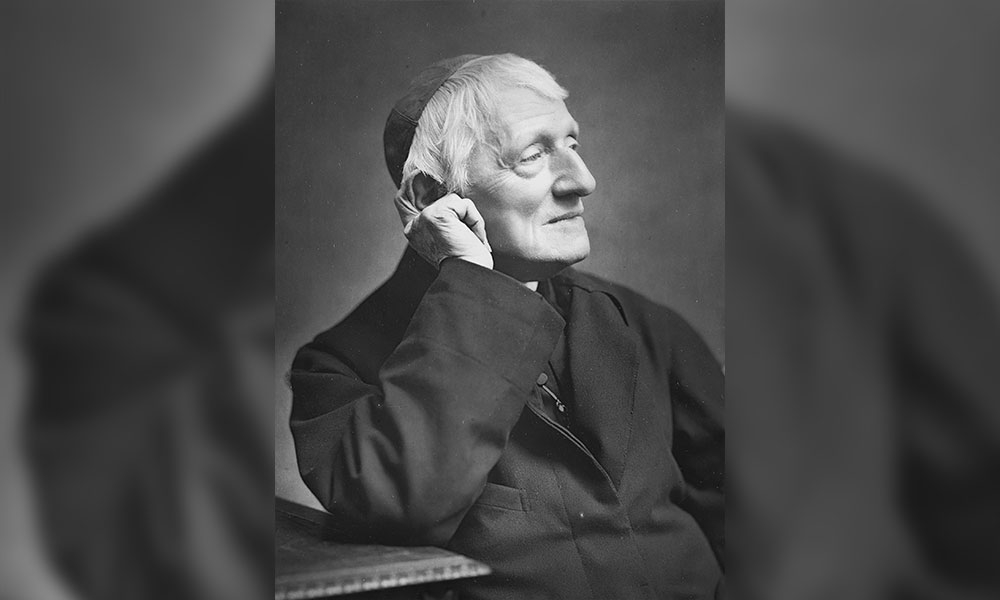
One of our newer saints celebrates his feast day on Oct. 9. John Henry Newman, the namesake of Cardinal Newman School in Columbia, was proclaimed a doctor of the Church on Nov. 1, 2025. His story is one of response to grace-upon-grace and ongoing conversion.
A recent biography of him by Father Hermann Geissler, FSO relates the life story and the faith journey of the famed English cardinal. Geissler describes Newman’s life in terms of three major conversions.
First conversion
The first was his conversion to the reality of a personal God. It seems the young John Henry was quite an intellectual, with a philosophical bent and a tendency to doubt. As a young teen, he moved from inklings that there was a God — but not necessarily a being who cared about creatures — to a conviction that there was indeed a God who was engaged personally. He began to see that Christianity made the best sense of who God is.
This “first conversion,” as Newman himself described it, was occasioned by study and a family crisis. By the time he was of college age, he committed to the Anglican Church, and at age 23, Newman was both an Oxford graduate and an ordained deacon. Anglican priesthood came shortly thereafter. He took to heart his need to grow in faith and in the care of souls, and to plunge more deeply into the history of Christianity and the depths of Christian doctrine.
Second conversion
Newman’s second conversion came with plumbing the wisdom of the ancient doctors of the Church, the richness of Christianity’s sacramental life and liturgical traditions. He preached on a variety of theological topics related to salvation and grace, the nature of the Church and questions of how faith and reason interact.
He became a founder of the Oxford Movement, which was intent on reclaiming the early roots of Christian tradition. In 1833, he penned the poem “Lead, Kindly Light” — a work which appeared in secular collections of classic English poetry. By the 20th century, it was reprinted in the collection of morning and evening prayer from the Divine Office used in Catholic convents and parishes across the English-speaking world.
Third conversion
His third conversion rocked the Anglican world. Newman concluded that the Roman Catholic Church was not somehow unfaithful to Christ, as he at one time thought. Rather, it was the clearest connection with the heart of Christianity and its apostolic foundations. It was the true Church.
When he was 44 years old, the one-time Anglican priest and celebrated Anglican theologian became a Catholic and moved briefly to Rome. Within two years, Newman was ordained a Catholic priest. Over the next 45 years, he became a much-read Catholic theologian, noted apologist, professor and champion of broad-based Catholic education.
Ultimately, he was named Cardinal Newman in the early days of the pontificate of Pope Leo XIII. He was cited by Sts. John XXIII and Paul VI and is often cited as an influence on the deliberations of the Second Vatican Council. Cardinal Newman was beatified by Pope Benedict XVI, canonized by Pope Francis and named a doctor of the Church by Pope Leo XIV.
Encircling gloom
None of this means that his series of conversions was untroubled.
Not surprisingly, he was thought too Rome-inclined by some of his Anglican colleagues well before his conversion to Catholicism. During his Catholic years, some influential clerics were suspicious of his ideas about the way Church doctrine develops over time.
Newman held that the Church, too, goes through some process of reform and reformulation as the whole community of faith grows in understanding, while remaining faithful to origins and foundational dogma and teaching.
He bore his crosses, and the “encircling gloom” mentioned in his “Lead, Kindly Light” certainly beset him.
Few of us will follow a path like Cardinal Newman. True, some of us have converted or reverted to Catholicism, while others have redirected their paths back to the straight and narrow. Some of us have had a cycle of callings which we first resisted — and we all have had things to repent.
One thing we can learn from the life of St. John Henry Newman is that a search for truth and commitment to it must drive us. When our consciences agitate us, we need to pay attention. When the voice of God utters even the slightest whisper, we need to listen. There is always more to come, and we cannot be unmoored when we find ourselves uncertain about where God is leading or what comes next.
This saint reminds us that God won’t invite us into anything that is contrary to the teaching of Christ, sacred Scripture and sacred Tradition. We can count on prayer, our eucharistic life and wise counsel. Yes, we may have to change course. Yes, we may find ourselves in unexpected roles and in unforeseen situations.
We can be confident, though, that our response to the call to continuous improvement and God’s will, in the end, will lead us to the brightest and most kindly of lights.
Sister Pamela Smith, SSCM is the diocesan director of Ecumenical and Interreligious Affairs: psmith@charlestondiocese.org.