The great O Antiphons of Advent
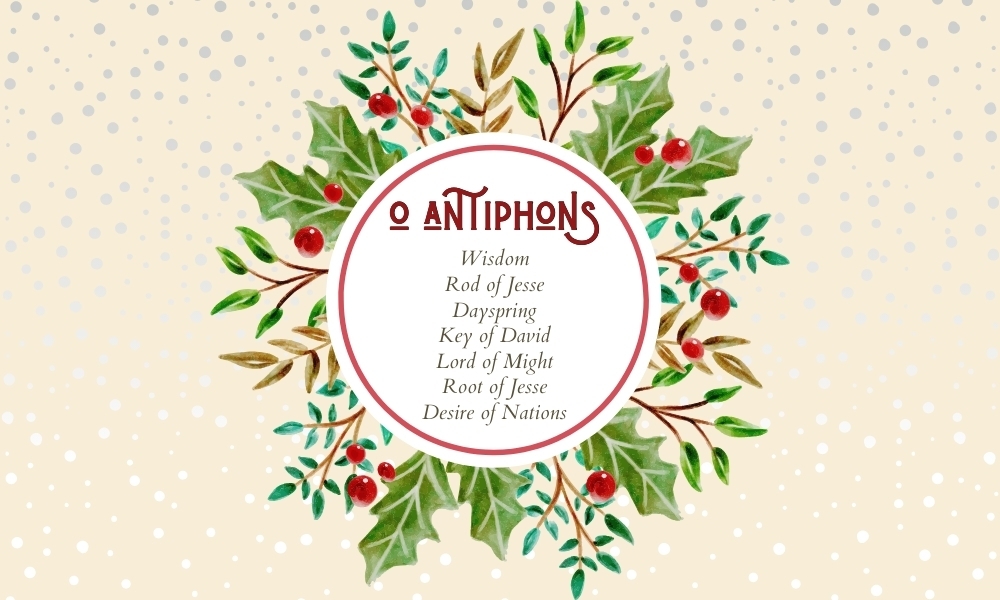
The great "O Antiphons" are sung each Advent from Dec. 17-24 and attached to the Magnificat during Vespers. Their author is unknown, but since the 800s they have formed the lyrics of "O Come, O Come Emmanuel."
The great "O Antiphons" are sung each Advent from Dec. 17-24 and attached to the Magnificat during Vespers. Their author is unknown, but since the 800s they have formed the lyrics of "O Come, O Come Emmanuel."
It's the English version of "Veni, Veni Emmanuel" most often sung by Catholics, but translated by John Mason Neale, an Anglican cleric.
The lyrics echo several prophetic themes. The title comes from Isaiah 7:14: "Therefore the Lord himself will give you a sign; the young woman, pregnant and about to bear a son, shall name him Emmanuel," a Hebrew word meaning "God with us."
A little history
The great "O Antiphons" are still chanted in many places in their original Latin plainchant form. Toward the end of Advent, these antiphons are attached to the Magnificat, the beautiful canticle of Mary. They have been in use for over a thousand years and form the seven stanzas of the well-known Advent hymn, "Veni, Veni Emmanuel."
Catholics most often sing the lyrics as translated by the Rev. John Mason Neale, "O Come, O Come Emmanuel." Neale, a scholarly Anglican cleric, translated many ancient Latin hymns into English, including the well-known "All Glory, Laud and Honor," often sung as a processional for Palm Sunday. The original carol "Good King Wenceslaus" also came from his pen.
The familiar melody called "Veni Emmanuel" was first linked to an early version of Neale's translation ("Draw Nigh, Draw Nigh, Emmanuel") in 1851, when Thomas Helmore published it in "The Hymnal Noted". Helmore found the tune in a 15th-century missal. He paired Neale's translation to a processional chant for funerals called "Bone Jesu dulcis cunctis." The same chant was used again when Neale reworked his translation. The present lyrics appeared in the very influential "Hymns Ancient and Modern" in 1861.
Neale, however, translated only five of the seven stanzas. It was not until 1915 that Henry Sloane Coffin translated the last two verses. The full seven-verse English version officially appeared for the first time in the magnificent collection "Hymnal of the Episcopal Church — 1940."
Prophetic theology
The Rod of Jesse refers to Isaiah 11:1: "But a shoot shall sprout from the stump of Jesse, and from his roots a bud shall blossom." Jesse was a righteous man, the father of David, Israel's greatest king. The prophecy indicates that from among Jesse's descendants would appear the Messiah.
Thou Wisdom is taken from Isaiah 11:2, where "The Spirit of the LORD will rest on him — the Spirit of wisdom and of understanding, the Spirit of counsel and of might." Isaiah's prophecy of the Messiah is one who will be anointed with this Spirit of wisdom. It also points back to the whole of Proverbs chapter 8, in which wisdom is personified and speaks as being with God from the beginning: "The LORD begot me, the beginning of his works, the forerunner of his deeds of long ago" (8:22-23).
Thou Dayspring is taken from the Benedictus, the great canticle of the priest Zacharias. In Luke 1:78, the father of John the Baptist declares that "because of the tender mercy of our God by which the daybreak from on high will visit us." (In the King James version, it's translated "the dayspring.") The Old English word means "dawn" or "sunrise," a messianic title. Zacharias was announcing that his family had been visited by the Messiah, the child carried in the womb of Mary, who came to help Elizabeth during her pregnancy.
Thou Key of David originates with Isaiah 22:22: "I will place the key of the House of David on his shoulder," which in turn refers to Isaiah 9:5-6: "upon his shoulder dominion rests … Upon David’s throne, and over his kingdom." Again, a messianic title denoting the importance of a descendant of the royal family.
Adonai, Lord of Might … from Sinai's height refers to Exodus 19:16-20 and 20:1-17, when God came down to Mount Sinai amid "peals of thunder and lightning, and a heavy cloud over the mountain." Adonai is Hebrew for "Lord." An interesting note when reading Scripture is that if LORD is in all capitals, it is a sign to the reader or cantor that Adonai has replaced God's Ineffable Name, YHWH, in the text.
Root of Jesse is taken from Isaiah 11:10: "On that day, the root of Jesse, set up as a signal for the peoples." The Messiah is not only the son of the house of Jesse, he is at the same time the source of the family's existence. Indicating the Messiah's eternal existence, Isaiah discloses Christ's divinity.
Desire of Nations is found in both the King James and Douay-Rheims translations of the Book of Haggai (Latin: Aggaeus). While some translations render the word "wealth" or "treasure," the Hebrew word khemdah is a collective singular, indicating the idea being expressed is plural. When Haggai 2:9 reads, "Greater will be the glory of this house the latter more than the former," he predicts visitations the Messiah would pay the Temple. I suggest that khemdah, in this case, specifies the same plural of majesty used by God in Genesis 1:26, "Let us make human beings in our image, after our likeness." The word khemdah, therefore, is another indication of the divinity of the Messiah found in the Old Testament.
The "O Antiphons" present us with a richness of theology upon which we may meditate as Christmas draws near, when we will welcome Emmanuel — Jesus, the incarnate God — to once more find his home in our hearts.
The antiphons
December 17
O come, O come, Emmanuel,
And ransom captive Israel,
That mourns in lonely exile here
Until the Son of God appear.
[Refrain] Rejoice! Rejoice! O Israel. To thee shall come Emmanuel.
December 18
O come, Thou Wisdom from on high,
Who orders all things mightily;
To us the path of knowledge show,
And teach us in her ways to go. [Refrain]
December 19
O come, Thou Rod of Jesse, free
Thine own from Satan’s tyranny;
From depths of hell Thy people save,
And give them vict’ry over the grave. [Refrain]
December 20
O come, Thou Dayspring, come and cheer
Our spirits by Thine advent here;
Disperse the gloomy clouds of night,
And death’s dark shadows put to flight. [Refrain]
December 21
O come, Thou Key of David, come,
And open wide our heavenly home;
Make safe the way that leads on high,
And close the path to misery. [Refrain]
December 22
O come, O come, Adonai, Lord of might,
Who to Thy tribes on Sinai’s height
In ancient times once gave the Law
In cloud and majesty and awe. [Refrain]
December 23
O come, Thou Root of Jesse’s tree,
An ensign of Thy people be;
Before Thee rulers silent fall;
All peoples on Thy mercy call. [Refrain]
December 24
O come, Desire of nations, bind
In one the hearts of all mankind;
Bid Thou our sad divisions cease,
And be Thyself our King of Peace. [Refrain]
Sean M. Wright, MA, is an award-winning Catholic journalist, Emmy nominee and master catechist for the Archdiocese of Los Angeles. Email him at locksley69@aol.com.