Finding their why
South Carolina’s recent growth in population and Catholicism is new and undeniable. Places like New York City have been making national headlines due to packed pews and a thriving young adult scene. Here in South Carolina, we’re also witnessing this dedication to Christ and a young Catholic “boom.”
South Carolina’s recent growth in population and Catholicism is new and undeniable. Places like New York City have been making national headlines due to packed pews and a thriving young adult scene. Here in South Carolina, we’re also witnessing this dedication to Christ and a young Catholic “boom.”
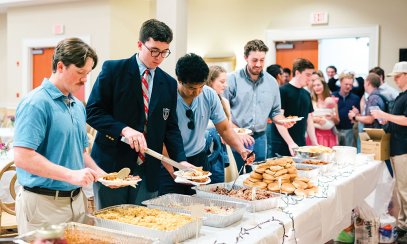
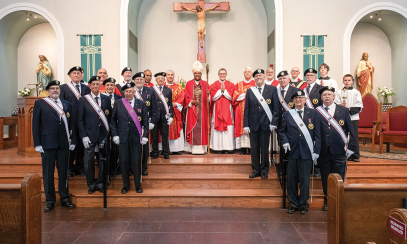
Across the state, schools like the University of South Carolina (USC), College of Charleston (CofC) and The Citadel are all seeing consistent growth in Catholicism among students. USC now serves more than 200 young adults at its weekly Sunday supper; College of Charleston saw more than triple its Mass attendance; and 22 cadets entered the Catholic Church this year at Easter, the most The Citadel has ever seen.
But how this expansion happens is the great surprise. It’s a result of the hard work and dedication of other young adults. Catholic students are in the dorms and classes, continuously showing up and sharing the light of Christ with their campus communities.
A living witness
Caleb Wilson is an incoming fourth-year cadet, who will serve as the regimental chaplain for The Citadel this academic year. Originally from New York, Caleb joined the Army National Guard at age 17, looking for a career and a future. After he entered training, he quickly realized it was his calling, and he specialized as an all-source intelligence analyst. After completing his training, Caleb was quickly deployed to Kuwait and Baghdad.
While deployed, he found that those who meant most to him, the people he said who inspired him, all seemed to have one thing in common: They were Catholic. While overseas, he began the process of joining the Church. He finished OCIA (Order of Christian Initiation of Adults) after returning home, joined The Citadel, and then received the rest of his sacraments.
Caleb has dedicated his time at the university to serving Catholic cadets and the Newman Center. He attributes the growing number of Catholics at the school to other students.
“To be a living witness, a living testament to God’s love, and showing that to each other,” he said, “I think that’s how we get to 22 people. And I think everyone on campus sees that.”
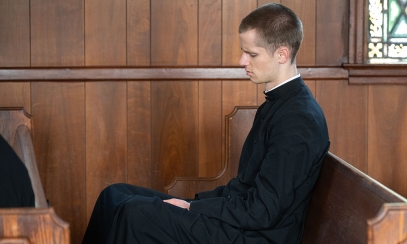
For the 2026-27 school year, Caleb will serve as the regimental chaplain, a role bestowed on a cadet who shows immense responsibility, dedication and care for his fellow students. Caleb is the first Catholic regimental chaplain in four years. The previous one, Joseph Ytem, is a diocesan seminarian.
In this role, Caleb has been put in charge of advocating for every student’s voice, faith and well-being. He will work alongside a team of 10 people, meeting weekly to discuss how the school can better serve its students and ensure every faith is represented. It is amazing to see cadets turn to the Lord in times of hardship, but surprisingly, the structure of the military can create a sense of longing for the faith.
“What is your why? Why are you here? Why did you wake up this morning and continue this? I think our ministry is really strong in the sense that we know our why. Our why is the Church. Our why is Jesus Christ.
Our why is God,” Caleb said.
After his senior year, Caleb said he hopes to attend graduate school to study international relations or law and to continue working for the government.
Transformative participation
Over the past few years, the College of Charleston has seen a boom in student leadership within their Newman Center. Kendall Mullen, the campus minister, was brought on just two years ago. She said she has seen participation completely transform.
Kendall said she attributes their success to the handpicked student staff she serves with. Chosen by the administration, student leaders have been allowed to grow the Newman Center on their own terms.
Calling you higher
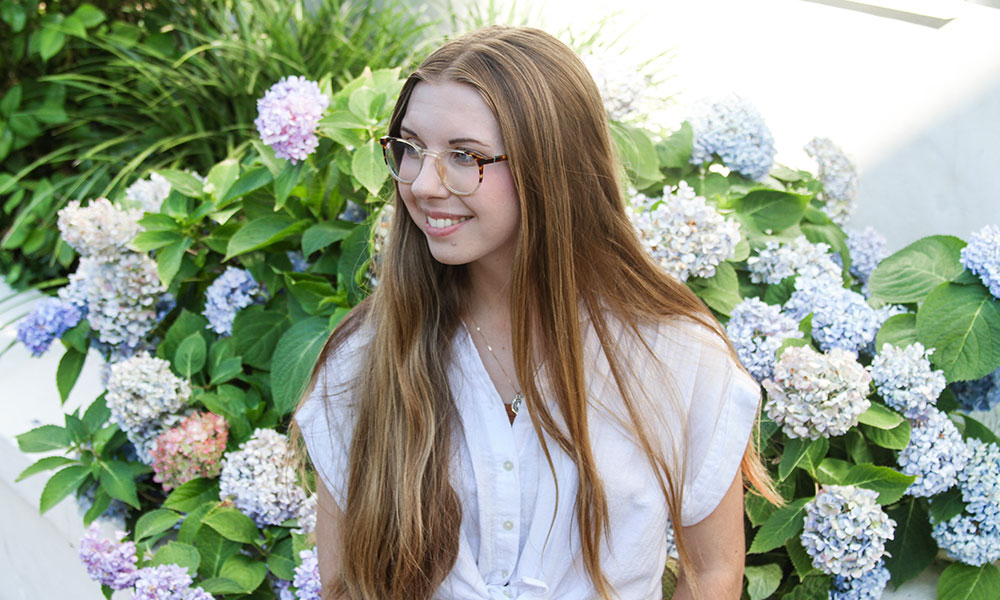
As a senior, Mary Carr was named president of the group and helped shape the ministry. As a founding member, she’s had a tremendous impact on her classmates by establishing a faithful women’s group as well as further opportunities for the group to connect beyond the classroom setting, something the program had lacked before.
Mary cultivated a safe and welcoming environment for students to join and call others to fellowship. Since the establishment of student leadership positions like hers, the Newman Center has seen numbers more than triple over the course of the last two years.
“I think the Catholic Church and our ministry, and the chaplains we have worked with, are really great at meeting you where you are and recognizing you are a college student and really acknowledging the struggles you're going through … not shaming you, but also not being content with you staying in that place; calling you to something higher,” she said.
At such formative ages, college students are called to choose this ancient faith for themselves, making jobs like Mary’s even more important and necessary. Campus ministers and student leaders often become important advocates for the faith at secular schools like CofC.
Now that Mary has graduated, she has taken a job working for the CofC’s Education Department as its social media coordinator.
Mary said she expects the Newman Center and campus ministry to keep growing.
“I think college students in particular are really craving the truth, really craving something beautiful,” she said.
On our college campuses around the state, they will find it in the Catholic Church and in the strong witness of faithful Catholic young adults.
Olivia Burtis is administrative assistant in the Office of Communications and a journalism and communications graduate of Benedictine College in Kansas. Email her at oburtis@charlestondiocese.org.