Entering into Christ
From time to time, I feel compelled to bring complicated theology down to an understandable level — to bring it down another notch so that I can understand it first. Recently, I began pondering St. Paul, who spoke often about our intimate connection to the risen Jesus.
From time to time, I feel compelled to bring complicated theology down to an understandable level — to bring it down another notch so that I can understand it first. Recently, I began pondering St. Paul, who spoke often about our intimate connection to the risen Jesus.
St. Paul said in his letter to the Galatians, “I have been crucified with Christ; yet I live, no longer I, but Christ lives in me” (2:20-21). Imagine this thought on your way to receiving holy Communion: we consume Christ’s body and blood, those cells mingle with the cells already in our body and we physically become one with Christ. Jesus is now truly living inside of us.
Just as our cells turn over constantly, it seems safe to assume that Jesus’ cells within us do the same. Therefore, we must replenish him within us by regular reception of the holy Eucharist.
Put on Christ
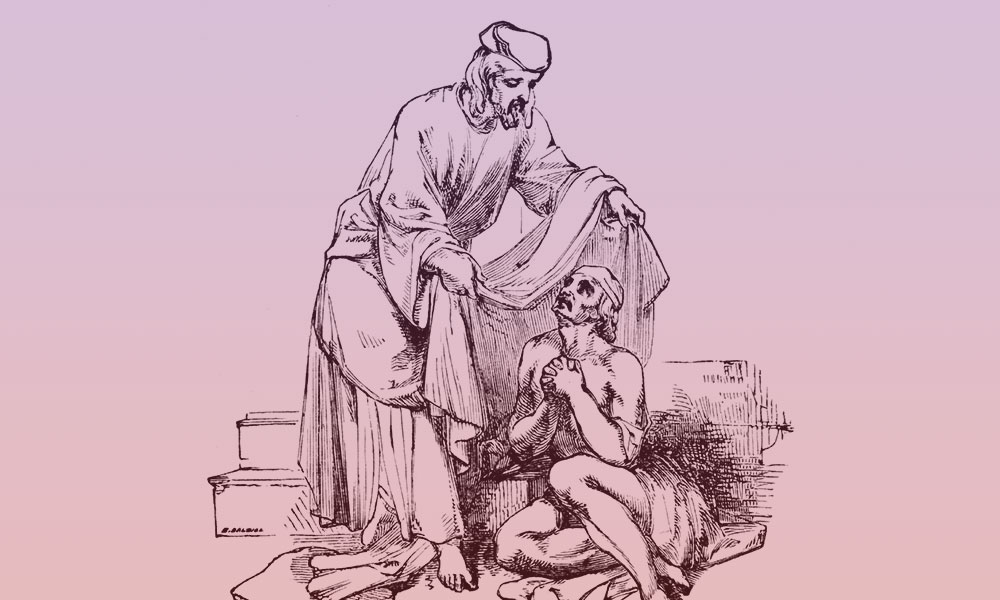
St. Paul went further in saying that not only does Christ enter into us, but we, in turn, should put on Christ (Rom 13:14) and clothe ourselves with Christ (Gal 3:27), implying that we are entering into Christ. Do we not enter into the clothes we put on? On a windy day, do we not enter into the wind and let it wrap around and envelop us? In a similar way, we can enter into Christ, put on Christ, be enveloped, wrapped, covered and encapsulated by Christ.
Certainly, we can agree that people sometimes “enter into sin,” into a sinful life, a downward spiraling existence that envelops them. Then, the opposite must be true, when we enter into Christ, where Jesus covers us with his way of being. With this thought comes another prayer to ponder before receiving Communion: “Lord, please enter into me, so that I may enter into you.”
Enter into Christ
The fourth-century patriarch of Alexandria, Athanasius, said the Son of God became man, “So that we might become God.” That sounds almost blasphemous, but it signifies that God is not a thing. St. Thomas Aquinas used the phrase ipsum esse subsistens, which means “subsistent act of existing itself” or “being itself subsisting.” God simply is and has revealed himself. While we cannot understand or imagine this fully due to our human limitations, we can still enter into that state of being, enter into God.
In holy Communion, there is a two-way exchange. First, Christ comes into us — his body and blood entering our humanity. Then, we are invited to enter into him by surrendering to the grace offered in Communion and choosing his will over our own. Together, these two movements reflect what Athanasius described: Christ taking on our human nature so that we might be drawn into his divine life.
The key distinction worth preserving is that our entering into Christ is not passive. It requires a choice to submit. Grace is given freely, but we have to yield to it.
Living in Christ
But what does it mean to put on Christ? What does one do, think or feel when clothed with Christ? How would others see and know that we have entered into Christ?
The echo this time will be one of the old guitar songs we used to sing in church: “They will know we are Christians by our love.” Dostoevsky said as much in his final novel, “The Brothers Karamazov,” when Madame Hohlakov confesses her fear that she is losing her faith in God. Father Zosima counsels her to go home and do active, practical acts of love toward her family, neighbors and everyone she meets. In doing so, she would gradually rediscover her God.
Visiting the sick, offering help to others, being generous to someone in need are all excellent examples of loving our neighbor. Perhaps the best and easiest example is to encourage everyone we meet, to build people up. First, look for the good in everyone we meet, then tell them! Yes, look a person in the eye and say, “I really like and appreciate how you …” Sometimes, we can actually make people better than they are simply by telling them the good we see.
Lastly, entering into Christ might be accomplished via the popular question, “What would Jesus do?” I mean, if we are living in Christ, and Christ in us, it would be inherent in our being to know exactly what Jesus would do. Then it is just up to us to make the choice to do it.
Thomas Dorsel, Ph.D., is professor emeritus of psychology and a graduate of the University of Notre Dame. He is a parishioner and cantor at St. Francis by the Sea Church in Hilton Head. Visit him at dorsel.com.