
When the saints start marching in, it might feel like an eternity
“Here is what sustains the holy ones who keep God’s commandments and their faith in Jesus. I heard a voice from heaven say, ‘Write this: Blessed are the dead who die in the Lord from now on.’ ‘Yes,’ said the Spirit, ‘let them find rest from their labors, for their works accompany them’” (Rv 14:12).
“Here is what sustains the holy ones who keep God’s commandments and their faith in Jesus. I heard a voice from heaven say, ‘Write this: Blessed are the dead who die in the Lord from now on.’ ‘Yes,’ said the Spirit, ‘let them find rest from their labors, for their works accompany them’” (Rv 14:12).
As reassuring as these words sound, we see their truth and strength challenged every day. However, when this same spirit is applied to our six Black Catholic saints-to-be, we discover that their works continue to sustain us.
Venerable servants
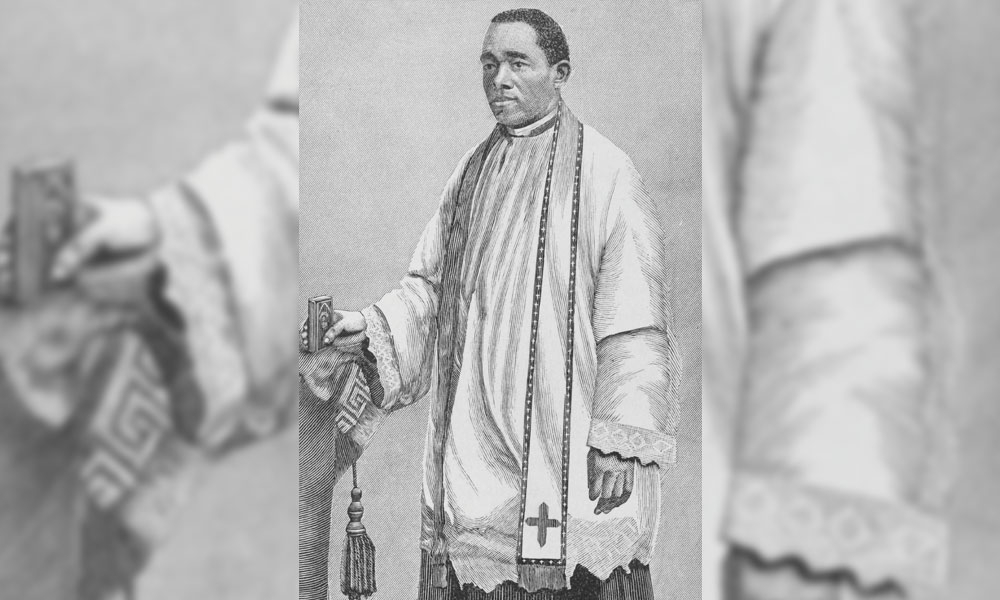
Venerable Augustus Tolton was our country’s first recognized Black priest and is also the one nearest to canonization. Servant of God Thea Bowman, of the Franciscan Sisters of Perpetual Adoration, has literally dozens of schools, colleges and even a public center in Wisconsin named after her.
Venerable Mother Mary Lange founded the order of the Oblate Sisters in 1829, the first order for Black nuns in this country. Henriette Delille, also venerable, founded the Sisters of the Holy Family in Louisiana in 1842. She also gave money to build Xavier University in New Orleans. Pierre Toussaint, declared venerable by St. John Paul II in 1996, was freed from slavery only after his mistress died in 1807.
Servant of God Julia Greeley, a Franciscan Sister, was enslaved in Missouri and freed from bondage by the state government in 1865, but not because the Civil War ended. The governor issued a proclamation that the border state Missouri end slavery in January 1865. Her cause for canonization was taken up by the U.S. Conference of Catholic Bishops (USCCB) in 2014.
All of these holy ones, in particular the Catholics who were enslaved, experienced an oppressive truth in their time. Belonging to the Catholic Church for them meant dealing with racial barriers, such as doors that were closed to African Americans who simply wished to worship and church galleries that were segregated. Augustus Tolton could not find a welcoming seminary in this country to accept him, and he had to complete his studies for the priesthood in Ireland.
Even today, surprisingly or shockingly, many Catholics do not know about any of the six incredible Black Catholics on the way to sainthood.
Storytelling & song
Bertha Elizabeth Bowman was born the granddaughter of formerly enslaved people in Yazoo City, Mississippi, in 1937. She converted to Catholicism at age 9 and later spent her life as Franciscan Sister Mary Thea. She was the order’s sole Black member. Her legacy of social justice and faith lives on through nearly 30 schools, missions, academies and even an interactive memorial center at her order’s motherhouse in La Crosse, Wisconsin.
Black Catholic historian Nita Clarke is the director of religious education at St. Peter Claver Church in Lexington, Kentucky. Clarke met Sister Thea when Bowman visited the parish in 1989 for a revival.
“When she walked down the hall singing, every hair on my arms stood up. I later had lunch with her with Deacon Boyd Marshall, who was then the first Black deacon in the Diocese of Lexington. She and I sat on the floor and ate fruit, talking about her illness and the world,” Clarke said.
“At the time, I didn’t know how important to us she was, having addressed all of the [U.S.] bishops about the subject of racism in the Catholic Church. But goodness gracious, I surely know now,” Clarke said.
In the late 1970s and the 1980s, Sister Thea gave several presentations around the Diocese of Charleston, and is particularly remembered for a presentation at St. Anthony of Padua Church in Greenville. She combined singing, prayer and storytelling with the goal of breaking down racial barriers and encouraged people to communicate with each other to better understand cultures.
“Looking back now, all I know is that I loved her like my own sister, and I was pleased to spend that time with her,” said Clarke.
Sister Thea died of cancer in 1990 at age 52, and the USCCB first opened her cause for canonization in 2018.
Not too quick
David Hess is a resident of Orangeburg, South Carolina, and the director of maintenance facilities for the Orangeburg County School District. A member of Holy Trinity Church, Hess said the Church’s lengthy canonization process shouldn’t be a fast one.
“Personally, I don’t want it to be very quick, and when it comes to Venerable Augustus Tolton, I really don’t want it to be rushed, because he is so important given his story as our country’s … first Black priest,” Hess said.
He added that the Church has some other candidates for canonization “who have waited for 60, 70 years or more and in Sister Thea Bowman’s case — and remembering the work that she did here in S.C. — I can understand why her order would want to see her name on the list. But it does not need to be rushed.”
“I am sure that you, myself and others might want” the process to be simplified, Hess said.
After all, our first Black Catholic American saint will be a cause for celebration and joy. Their good works, still living, thriving and moving the Church ever forward “accompany them,” and us.
Robert Alan Glover is an alumnus of the University of Dayton, where he earned a bachelor’s degree in social work and studied theology: martinique1902@yahoo.com.