
When numbers add up to life or death
Patients in the Palmetto State who suffer from internal organ failure could all use a healthy dose of spiritual healing and more time: Healing first, but should that fail, more time for one’s life and living it with loved ones.
Patients in the Palmetto State who suffer from internal organ failure could all use a healthy dose of spiritual healing and more time: Healing first, but should that fail, more time for one’s life and living it with loved ones.
South Carolina, however, currently leads the nation with the highest per capita ranking of people on kidney waiting lists. As of early 2026, approximately 1,800 state residents were on the organ transplant list. The need for kidneys is the most critical, with between 1,474 and 1,695 people currently waiting — nearly 90% of all patients on the state’s list. By comparison, only 77 people in South Carolina are waiting for a heart transplant. Tragically, Black South Carolinians are disproportionately represented, making up 56% of the total waiting list (SharingHopeSC.org, NationalKidneyFoundation.org).
In Part 1 of this two-part series, we explore the human side of surviving through organ donation.
The Church’s perspective
Kathy Schmugge is the director of the diocesan Office of Family Life, where her responsibilities include end-of-life issues, bioethics, special needs, caregiving, healing ministries and more. She said the importance of organ donation ties directly into the Church’s pro-life stance.
“An organ donation can be a sacrificial gift that can restore health to another person. It must be given without manipulation or force. The person should not die in giving the organ which, if given by a brain-dead patient, had to have consented before providing the organ, and their brain death properly determined,” Schmugge explained.
She added that it’s important “to have a clear indication that the person is truly brain-dead as determined by three different doctors.”
The Church’s teaching is clear on where the moral line falls.
“St. John Paul II considered [it] a noble act. When given by a living person, such as a kidney, it is a sacrificial and totally loving act. When the organ donation will kill the person or [is] taken without [that person’s] permission, that would be an immoral act,” Schmugge explained.
A friend’s gift
At age 28, Amy Stark was, as she recalled, leading an active life. She’d served as a youth minister and was then in a convent as an aspirant.
“I had had signs of kidney problems for some time, but because I moved often, and saw different doctors, the symptoms were not connected together,” she said.
By the time she was diagnosed, it was already too late for early intervention.
“I was already in end-stage renal failure. I ended up in the ICU with extremely high blood pressure and underwent extensive testing to determine the cause. Blood work confirmed kidney failure, and I began peritoneal dialysis immediately, continuing it for three years,” Stark said.
What followed was an act of friendship that the Church would recognize as profoundly sacrificial.
“In 2008, a close friend from my university days donated [one of] her kidneys to me. It was not a perfect match, but close enough, and we decided to go with it,” she said.
The transplant opened a life Stark might never have had.
“Three years later, I married, and eventually had two children with the transplant. Both pregnancies were very difficult — I had two daughters born prematurely at 30 and 34 weeks respectively — putting significant stress on the kidney; but it held up my ‘baseline’ (original post-transplant function figure) afterward.”
Schmugge, who supported Stark and her husband throughout, remembered the scope of that community of care.
“We visited them while they were in the hospital in Charlotte, North Carolina. We had so many people praying for her high-risk pregnancy. I also arranged with a local priest to administer the sacraments to her infant who was in the NICU after birth,” she said.
Stark’s college friend, meanwhile, went on to graduate, get married and is now the mother of five children.
“I have had my kidney now for 17 years, and continue to have good function,” Stark said. “I am also deeply grateful for the gift of the transplant, as all of us on this journey are, and honestly still [in] awe that I’ve been able to have two children after everything.”
Leukemia and a new life abroad
Schmugge first met Alicia Tosca when Tosca “was a college student and part of a female discernment group I was leading at Winthrop University. She later worked in youth ministry and we stayed in contact. When she got sick, I started prayer chains, checked in on her progress, and I visited her whenever possible.”
Tosca had long dreamed of living in Scotland, having first visited the country at age 9 for her aunt’s wedding. That dream was put on hold during Holy Week in 2016, when she was diagnosed with leukemia.
“After chemo, remission and stem cells transplant, my prognosis was positive, with an initial goal line of 2.5 years of continuous remission, but the prize of being confidently ‘cured’ would be five years of remission,” she said.
Those years carried their own quiet weight.
“So, for nearly five years I held my breath, worried at every check-up, at every bump in the road, every symptom of GVHD (graft-versus-host disease, when transplanted donor T-cells recognize the recipient’s tissues as foreign), any ache, bruise or sign of fatigue. It was exhausting,” she said.
“Then one day I really realized I didn’t have to live in fear or wait until that five-year goal to live my life, to enjoy the immeasurable gift I received. I could do it now, today.”
That decision led Tosca to pursue dual citizenship and, in September 2020, to fly to Glasgow — quarantining near Greenock before crossing the River Clyde to settle near family. She has been there since.
What has grown alongside her new life abroad is a deepening connection to the gift that made it possible, and to the man who gave it. Two years after donating his stem cells, Tosca met the resident of Cologne, Germany, face to face in April 2025.
“I was fortunate he wanted to share his name, hometown and contact details with me. I expressed my gratitude to him for his donation and how [it had helped] my health, and he replied in kind how happy he was to be a stem cell donor,” Tosca said.
She described her donor as “generous, very kind, empathetic, passionate and welcoming to strangers. We visited again last September and are planning to see each other this June to celebrate life — and 10 years since our transplant!”
Learn more
Part 2: Next month we will examine the medical side of organ donations: a world filled with procedures, rules and an outnumbered demand for several organs that too often determines the candidate who does or does not receive this blessing.
How you can help
For those moved by these stories, the following organizations support stem cell and organ donor registration, donors and patients:
- Sharing Hope SC: sharinghopesc.org
- National Kidney Foundation: kidney.org
- National Marrow Donor Program: nmdp.org
- Anthony Nolan (international): anthonynolan.org
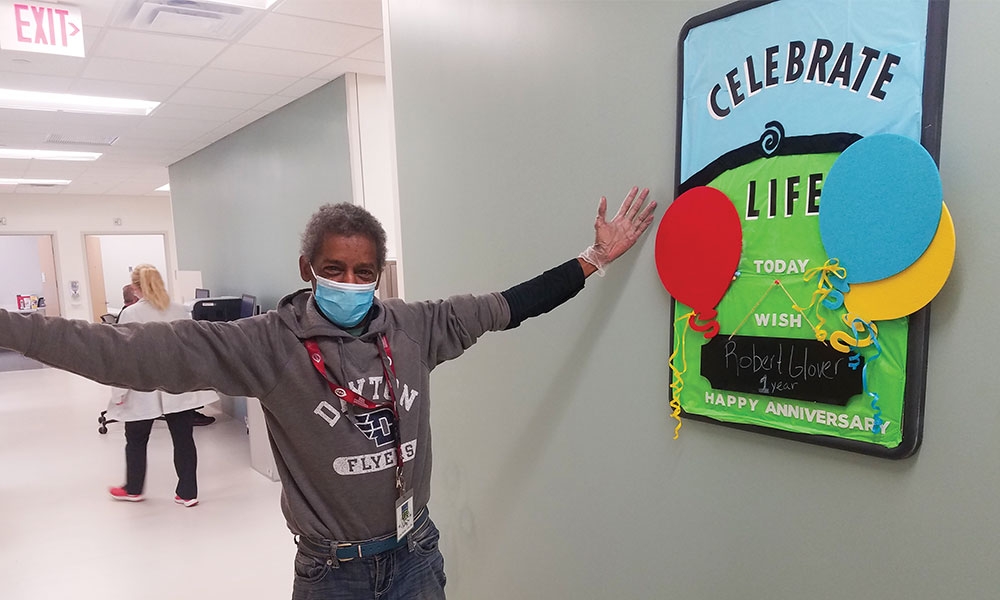
Robert Alan Glover (pictured) is a two-time survivor of kidney failure who spent three years on two waiting lists. He received a new kidney in 2019. He is a long-time writer for many Catholic media outlets. Email him at martinique1902@yahoo.com.