
The state of the permanent diaconate in the Diocese of Charleston
The permanent diaconate throughout South Carolina is strong thanks to good leadership. Bishop Jacques Fabre-Jeune, CS, his predecessor Bishop emeritus Robert E. Guglielmone, and the various directors of the Permanent Diaconate Office since 2010 have created a robust diaconate that continues to grow in numbers and fervor.
The permanent diaconate throughout South Carolina is strong thanks to good leadership. Bishop Jacques Fabre-Jeune, CS, his predecessor Bishop emeritus Robert E. Guglielmone, and the various directors of the Permanent Diaconate Office since 2010 have created a robust diaconate that continues to grow in numbers and fervor.
In the Church, there are three degrees of holy orders. Only a bishop has the fullness of the sacrament as a successor to the apostles. A priest, as sacerdote, is ordained to be Christ the Head. Then a deacon, the lowest of the holy orders, is ordained to be Christ the Servant.
Defining 'deacon'
There are two words that should define a deacon — diakonia and kenosis, both Greek words. Diakonia means service, while kenosis means self-emptying. Deacons carry out the duties of their ordination in word, liturgy and charity. They must do so with self-emptying love and serve with great joy. Deacons proclaim the Gospel while assisting at the altar. Many teach catechetical classes, Bible studies and the Order of Christian Initiation for Adults (OCIA). They also visit shut-ins and those who are ill or imprisoned, and serve the poor and marginalized.
By the numbers
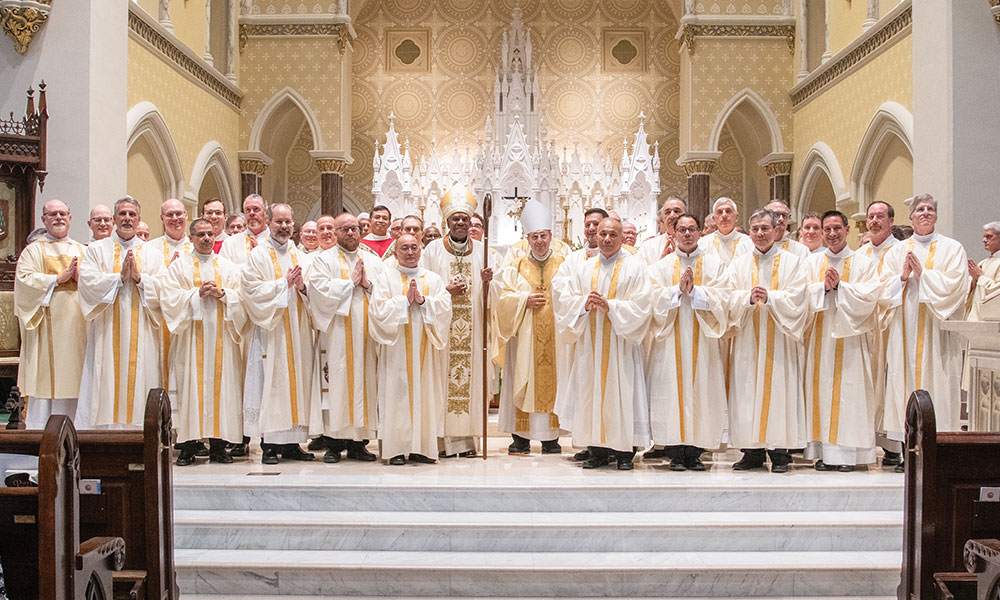
In our diocese, we currently have 235 permanent deacons: 176 are incardinated into our diocese and 59 have moved here from other dioceses (no one retires and moves up north!). Of those, 173 are actively working in parishes and in other ministries.
While most deacons are caucasian, we do have Hispanic, African American, Asian and even one Native American deacon. Since 2016, the average ordination class has had about one-third Hispanic men, and this past February the bishop ordained our diocese’s first Vietnamese deacon.
Permanent deacons are required to make an annual retreat and join in a Day of Prayer. They are also required to take 15-25 hours of ongoing formation each year.
However, despite having nearly 250 deacons once the 2026 class is ordained, nearly 100 men are aged 70 or older. This is why Bishop Fabre continues to have a formation class every two years if there are sufficient qualified men.
We anticipate 11 men to be ordained this February and 13 more in 2029. The 13 men in the class of 2031 just began their discernment year.
Forming servants
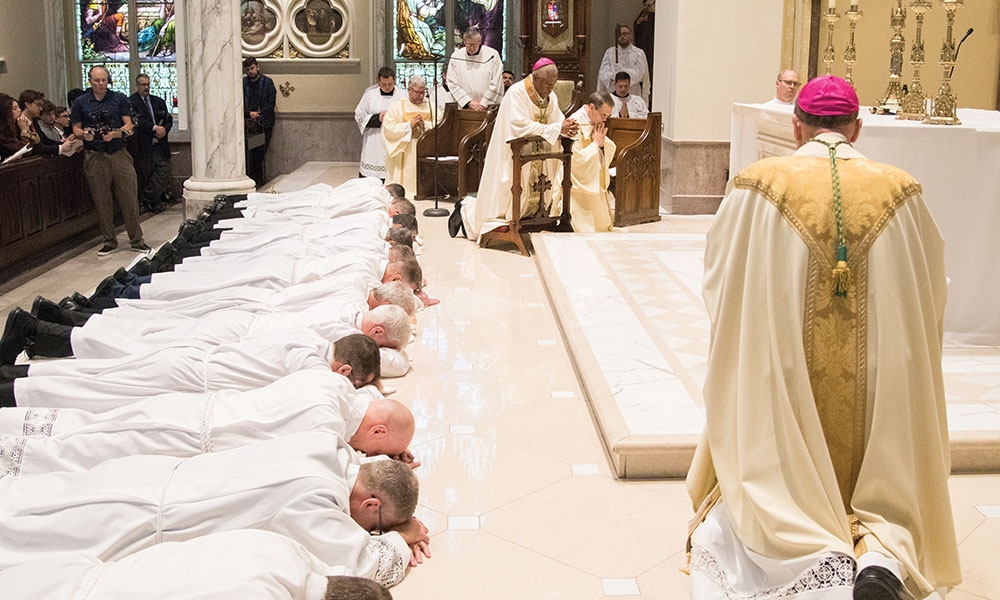
It takes five and a half years to make it through formation classes to become a permanent deacon. While no one has a right to be ordained, each candidate knows if he is truly called to this vocation when the bishop’s hands are on his head at ordination.
However, it is our duty to properly prepare men to serve the bishop, usually in working with priests at the parish level and with the people of God.
Men who are interested in the diaconate should be 35-60 years old at time of application, in good standing with the Church, sacramentally married for at least five years if married, a Catholic for at least five years and either a U.S. citizen or a permanent resident. After filling out an application, single men or couples will then be interviewed by the Diaconate Advisory Board, and the candidate will take a psychological assessment.
Then, the director and formation director, in this case, myself and Deacon Brian Justice, will present their recommendations first to the vicar for clergy, and then to the bishop for final acceptance to begin.
Discernment continues throughout the program. For those who are married, the candidate and his wife must agree each year to his ongoing formation to honor his first vocation of holy matrimony.
Practically speaking
We see an example of diakonia, or service, when Jesus washes the feet of the disciples at the Last Supper. In Chapter 6 of the Acts of the Apostles, we read of the selection of the first seven deacons (including St. Stephen, the first martyr) and the laying on of hands by the apostles. Deacons, as a separate vocation from the priesthood, formed a prominent part of the early Church. For various reasons over time, the diaconate simply became a step to the priesthood.
But Holy Mother Church, in her wisdom, restored the permanent diaconate in 1967, not because of a shortage of priests but because of a shortage of deacons. This was, in large part, thanks to the efforts of Charleston Bishop Ernest L. Unterkoefler. The first man ordained for the Diocese of Charleston was Deacon Joseph C. Kemper on Aug. 10, 1971.
Deacons are clergy who have one foot in the Church and one foot in the world. We work where you work. Most of us are married. As a “medial” order, we bring Christ to the world, and we bring the world to Christ. We work with our bishop and his priests to spread the Good News of Jesus Christ and salvation, while serving to build up his kingdom on earth, and especially here in South Carolina.
Deacon Regi Armstrong was ordained to the permanent diaconate in 2002. He is the director of the Office of the Permanent Diaconate and is also assigned to St. Anthony Church in Florence. He and his wife, Hsin Yi, have three children and seven grandchildren. Email him at rarmstrong@charlestondiocese.org.