
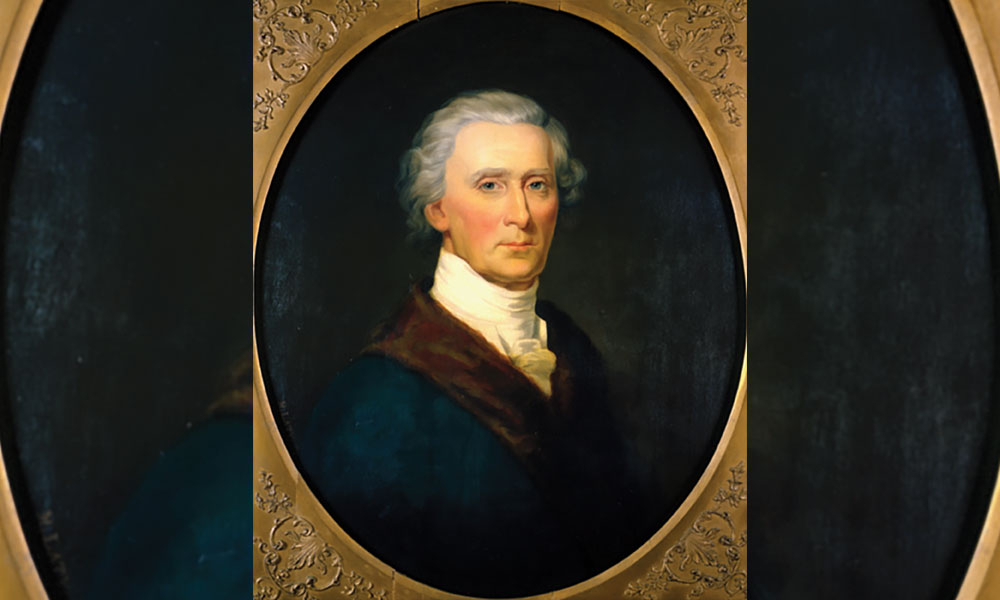
Charles Carroll of Carrollton: A lone Catholic rebel in a Continental Congress
During this semiquincentennial — the official way of saying “250th” — anniversary of the adoption of the Declaration of Independence, it is fitting to realize that one solitary Catholic was allowed to sign that crucial document.
During this semiquincentennial — the official way of saying “250th” — anniversary of the adoption of the Declaration of Independence, it is fitting to realize that one solitary Catholic was allowed to sign that crucial document.
Catholics in the colonies
The apostolic endeavors of missionaries accompanying French, Spanish and Portuguese explorers graced the New World. In the 1500s, the Catholic faith found a permanent home in the southern regions of what became the United States. Not so in the mid-Atlantic colonies of New England and New Amsterdam. No Catholic crew sailed in the English ship Mayflower or in the Dutch ship Fortune.
The Church of England was established in Virginia and elsewhere, whilst dissenters such as Congregationalists and Presbyterians established themselves in other colonies. All had laws, more or less enforced, barring Catholics from being educated, voting, holding office, practicing law or engaging in public worship. Only Pennsylvania, founded by peace-loving Quakers, allowed Catholics to build chapels without hindrance.
King Charles I granted a proprietary colony in 1632 to George Calvert, 1st Baron Baltimore, as a refuge for Catholic settlers. Called Maryland, it ostensibly honored Henrietta Maria, Charles’ Catholic queen consort. Cecil Calvert, 2nd Lord Baltimore, established what became the colony’s first capital, St. Mary’s City. The holy sacrifice of the Mass was openly celebrated for the first time in an English colony on March 25, 1634, the day the ships The Ark and The Dove landed with the first colonists — a date annually celebrated by the state as Maryland Day.
The Maryland Toleration Act allowed anyone who believed in Jesus Christ to settle there. Puritan rebels seized the colonial government in 1650, burning churches and persecuting Catholics, before the Calvert family regained control in 1658.
The Carroll family legacy
In 1689, the first Charles Carroll arrived from Ireland, appointed attorney general under Baron Baltimore. When William and Mary removed the Calvert family as proprietors in 1691, Carroll refused to renounce his faith, was stripped of his position and imprisoned. He later married and acquired land, becoming the colony’s wealthiest landowner by his death in 1720, quietly welcoming Catholics to his home each Sunday for Mass.
His son, Charles Carroll of Annapolis, inherited and extended that fortune. As a Catholic, he was forbidden from participating in Maryland politics, yet he and his wife continued working to curb anti-Catholic hatred and promote the faith. They lived to see their son secure the family’s vision of personal, political and religious freedom for all citizens.
That son was the third Charles Carroll, born in Annapolis in 1737, who adopted the name “of Carrollton” to distinguish himself from his father. At age 10, he was secretly sent to study at Bohemia Manor, a clandestine Jesuit school in Maryland, where his cousin John Carroll — destined to become the first archbishop of Baltimore — was a fellow student. Both continued their studies with the Jesuits in Europe. Charles went on to study law at the Inner Temple in London before returning to Maryland.
A patriot and public servant
The Carroll family fortune was enormous, equivalent to some $375 million today. Despite being the wealthiest man in the colonies and thus having the most to lose, Charles staunchly supported colonists’ rights against King George III’s policies. In 1770, when the colony’s governor imposed a fee by proclamation, Charles defended Marylanders’ right to tax themselves through representative government. Writing in the Maryland Gazette, he gained a reputation as a thoughtful scholar and skillful debater. After appointments to the Annapolis Committee of Correspondence and Council of Safety in 1774, his election to the 2nd Maryland Convention effectively ended the ban on Catholics serving in Maryland politics.
In 1775, Charles was elected one of four Maryland delegates to the 2nd Continental Congress. Early in 1776, along with Samuel Chase, Benjamin Franklin and the now-ordained Father John Carroll, he was appointed commissioner to Canada, though the mission failed to secure that colony’s support. With Chase, Charles persuaded the Maryland Assembly to vote in favor of independence. Together with many other delegates, he did not sign the Declaration until Aug. 2, 1776.
Charles helped write Maryland’s first State Constitution and Declaration of Rights in 1776, served in the Maryland Senate, and was elected Senate president in 1783. His cousin Daniel Carroll assisted in framing the United States Constitution, authoring the 10th Amendment. With its ratification in 1789, Charles became one of Maryland’s first two senators.
Later, through his civic efforts, St. Mary — the first sanctioned Catholic church in Annapolis — was erected on the Carroll property in 1822.
On Nov. 14, 1832, Charles Carroll of Carrollton died, a true statesman and public benefactor. He was the last surviving signer of the Declaration of Independence, that powerful document proclaiming liberty to all men endowed by their Creator with certain inalienable rights.
Sean M. Wright, MA, award-winning journalist, Emmy nominee and master catechist for the Archdiocese of Los Angeles, is a parishioner at Our Lady of Perpetual Help Church in Santa Clarita, California. Email him at locksley69@aol.com.