The Big 4: Phone, wallet, keys, rosary
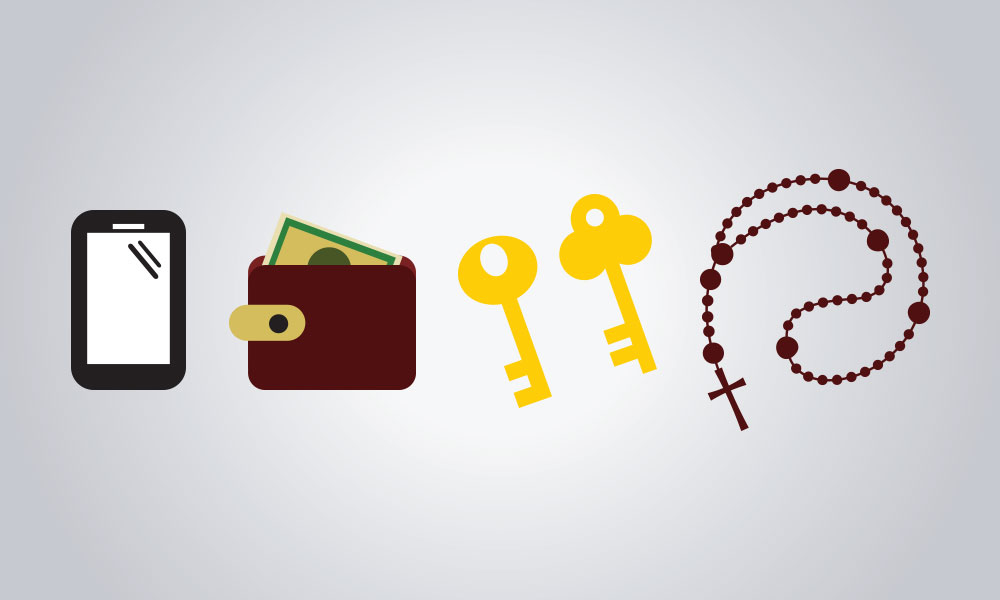
Everyone knows about the big three that you can’t leave home without. Yes, the Holy Trinity is a bigger three, but I’m specifically talking about your phone, wallet and keys. In my family, the rosary always accompanies these essential items to form a quartet that covers all our immediate commuter needs.
Everyone knows about the big three that you can’t leave home without. Yes, the Holy Trinity is a bigger three, but I’m specifically talking about your phone, wallet and keys. In my family, the rosary always accompanies these essential items to form a quartet that covers all our immediate commuter needs.
Every weekday morning driving into work, I call my wife and baby girl, and we pray the rosary — not just because South Carolina drivers are just a little unpredictable, but because it’s a commitment we made to each other to carve out a moment of our crazy day for Jesus and Mary. The rosary is one of the most powerful and prolific devotions in our Christian tradition for many reasons. First and foremost, the repetitive nature of the Our Father, Hail Mary and Glory be combination transports the heart, mind and soul into scenes from Scripture; in many senses, it transports us into the Beatific Vision.
Mindful repetition
As an example, take the sorrowful mysteries, my favorite. When we pray the mystery of the agony in the garden, we are invited to reflect on that dark night where Jesus sweated blood over the sufferings he was about to endure for our salvation. As we enter this meditation, we peer behind Jesus to see his closest apostles, unbothered, asleep on the sandy earth as the olive tree roots and pebbles imprint themselves on their skin.
Then we hear Jesus’s voice — weary, strong and simultaneously gentle — rebuking them, “So you could not keep watch with me for one hour? Watch and pray that you may not undergo the test. The spirit is willing, but the flesh is weak” (Mt 26:40-41).
At that moment, we are invited to think about how we may have fallen short of what God has called us to do. It makes us share in the feelings of shame that Peter and Zebedee’s sons must have felt, and it deepens the love inspired by Christ’s selfless sacrifice despite our flaws. All the while, we recite with our mouths the prayer that our triumphant Savior taught us how to pray.
We echo the salutation of the angel Gabriel and the jubilant words of Elizabeth as she greeted Mary in the hill country of Judea. To conclude each mystery, we recite the Glory be, a prayer that the earliest Fathers of the Church used to profess God’s eternity and to correct the errors of the Arian heresy.
The legacy of Christian prayer
Through its rope, beads and crucifix, the rosary binds us to an unbroken chain of Christianity that has existed since the apostles and their spiritual descendants, lay and ordained. Within the first three centuries of Christ’s ministry, desert hermits began to use stones and knotted strings to count out repetitive prayers.
As time progressed, monks of the Middle Ages prayed all 150 Psalms each day, and the laity who were unable to read commonly recited 150 Hail Marys. This later became known as the “poor man’s psalter,” or “Our Lady’s Psalter.” To keep track, a string with beads became more mainstream.
After centuries of devotion and prayer in similar forms, a pious legend emerged, narrated later by St. Louis de Montfort and Blessed Alan de la Roch. According to this legend, Mary appeared to St. Dominic with the rosary in the form we recognize today — groups of 10 Hail Marys divided by the Our Father prayer — all connected to a spiritual “mystery.” Shortly after, the Hail Holy Queen was added to demarcate the conclusion of the rosary, standardized by the Order of Preachers (Dominicans).
When we pray the rosary prayers, we are connected to the saints and our spiritual forebears, drawing ever closer to hearing the voice of Jesus Christ.
The promises of motherly protection
The rosary serves another important and often overlooked purpose: it is a means of protection for the family, the Domestic Church and every individual who recites it. Revisiting the St. Dominic era of the rosary prayer, we learn that Mary made 15 promises to every person who recites the rosary faithfully. Among them, the rosary is described as “a powerful armor against hell.”
Throughout life, the contest of our choices between good and evil which St. Paul described at one point as “the good fight” (2 Tm 4:7), the rosary acts as a spiritual buffer. It assuages temptations, anchors us in our resolve as bearers of the Great Commission and encourages us in our hour of need. We know that God’s own Mother stands at the foot of his throne and advocates for each one of those who cry out to her for maternal guidance.
These promises have been affirmed through the apparitions in Fatima and Lourdes, where Mary urged all Catholics to pray the rosary daily for the salvation of souls. As St. Padre Pio famously stated, “The rosary is the weapon for these times.” And again, “If you practice no other devotion in the spiritual life, pray the rosary.”
Parents are the custodians of the souls of the children in their homes. The protective nature of the rosary is one of the primary reasons that we choose to pray the rosary every day, and we strongly encourage others to do the same.
A moment of communion
The last aspect of the rosary that we explore here is the communal aspect of verbal prayer in the home. As Jesus said, “For where two or three are gathered together in my name, there am I in the midst of them” (Mt 18:20). A group rosary led by Mom and Dad is perhaps the most clearly visible sign that Christ is welcome in this place, and that he and Mary are honorary members of our family. It’s the closest thing most people will have to Mass outside of Church, because at this gathering we all profess that Christ is Lord, the Incarnation happened, his mother is crowned above and that we share a commitment to bring each other to heaven.
The rosary is spiritually, doctrinally, scripturally, historically rich. It can be invoked in times of thanksgiving, in times of grief and in times where we need to better illuminate the path that Christ calls us to follow.
So, before you leave the house today, make sure you have a rosary handy. Then you can dig for the keys behind the couch and bother St. Anthony.
Daniel A. Jost III is the diocesan public relations specialist for Communications: djost@charlestondiocese.org.