
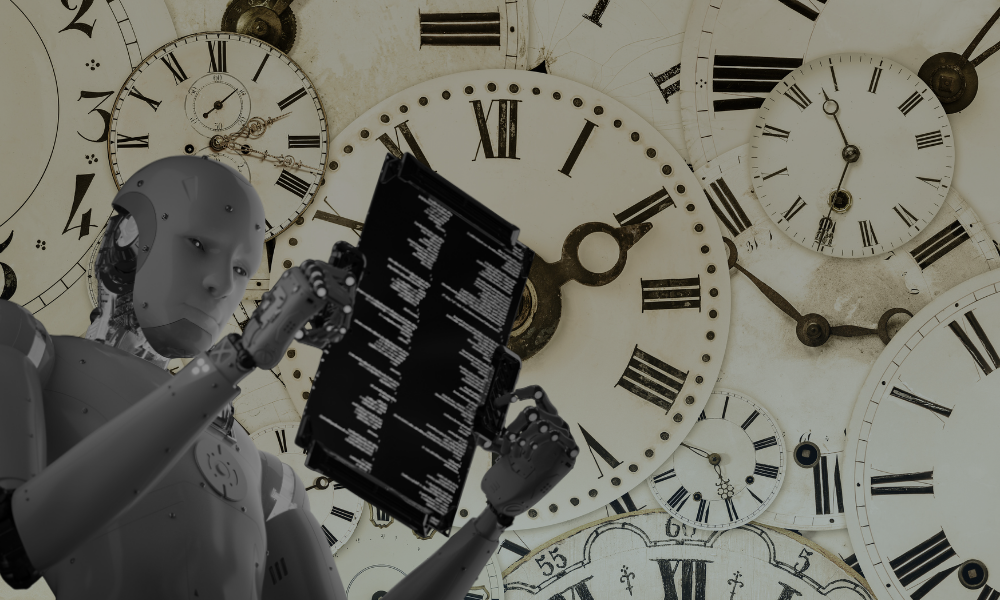
AI promises to save us time, but what will we do with it?
In recent years, the arrival of A.I. has exploded as a topic of discussion, question, excitement and fears. Ahead of Pope Leo XIV's Magnifica Humanitas publishing this month, A.I. has been a subtle, largely unnoticed part of our lives for a long time.
In recent years, the arrival of A.I. has exploded as a topic of discussion, question, excitement and fears. Ahead of Pope Leo XIV's Magnifica Humanitas publishing this month, A.I. has been a subtle, largely unnoticed part of our lives for a long time.
But, in 2023, when the viral launch of the seductively user-friendly ChatGPT brought A.I. into our homes, schools and offices, we were forced to confront the far more profound impacts of A.I, for which ChatGPT plays only a minor part.
I find myself thinking a great deal about what A.I. might mean in academic life as both help and hinderance to my students’ education and what its implications are for academic integrity and the future of scholarly research and writing. I also struggle with deciding what I should be teaching my students about using A.I., knowing that their employers and clients will expect that they will productively harness this enormous power in the workplace.
Others who are far wiser and more experienced than I am are thinking deeply about the much broader and deeper implications of A.I. today and tomorrow. Indeed, Pope Leo XIV is at the heart of many contemporary discussions on the profound ethical questions raised by this new tool, with his first encyclical devoted to it. What will A.I. mean for human agency and accountability? How easy will it be to manipulate A.I. to exert profound social influence?
In deep moral quandaries posed by such things as medical care and warfare, how could A.I. lead decision-makers down paths we should not go? What will A.I. do to shape our understanding of personhood and of human values? How close might we be to creating a technology that we may not be able to control? What will happen to human wisdom? Intriguingly, we have named this creation “artificial intelligence” not “artificial wisdom.” Does this acknowledge that wisdom is uniquely irreplaceable?
I do not know.
But there is another, far more mundane question that has not yet received much attention — largely, I think, because it is not a new question raised by A.I. but an old question asked with the advent of all new technology. This question is, simply, what will we do with all the time A.I. should save us? One of the main reasons that students, employers, researchers and others embrace A.I. is the promise that it will save us time by taking mundane tasks off our plates and handling complex jobs faster than we could on our own. All of this, we are promised, will save us time.
This same hope is one we hear any time that innovative technology makes a task faster and easier. When I compare my daily life to that of my grandparents, I see that in the span of merely two generations, the work that filled their days can be done far faster and more easily today.
Our computers, the internet, kitchen appliances, faster cars, power tools, on-line shopping, microwave ovens, online banking, GPS systems, rapid communication and remote work all promised to save us time and return to us that most precious gift of additional minutes, hours, days and weeks.
Yet, I am not sure that all of this promise has been realized.
Today, we seem to be busier and more stressed than ever. Family life does not seem to benefit from an infusion of extra time to spend together. Vacation days go unused by so many. Community activities from bowling leagues to volunteer groups often fade from the local scene as we become too busy for the activities for which our ancestors found time.
Our elderly sisters and brothers often live their days without visits from the over-scheduled, under-rested younger generations. Participation in regular religious activities has declined through the years, and the American Time Use Survey published by the Bureau of Labor Statistics (American Time Use Survey News Release - 2024 A01 Results) generally shows a steady decline in the percentage of people engaged in many aspects of our common, community life and a decline in the amount of time that they spend.
If it is true that A.I. will, among other things, make us more efficient in the use of our time and better able to accomplish ever more, ever faster, then it might be worth reflecting on what we will do with the time that we might save. Will we spend it using our gifts and talents in the service of others, in ways that A.I. cannot? Will we lavish it on our loved ones as a precious gift? Will return it to God who gives us 8,760 irreplaceable hours each year of our lives? Will we spend it in holy re-creation, refreshing ourselves in mind, body and spirit?
There is much about A.I. that raises new questions for humanity. But, the question it raises about time is, well, as old as time: How may we best use this newfound time in ordinary time?
Lucia A. Silecchia is a professor of law at The Catholic University of America. Email her at silecchia@cua.edu.