The adoration of the bells
“Shout joyfully to the LORD, all you lands” —Psalm 100:1
“Shout joyfully to the LORD, all you lands” —Psalm 100:1
For centuries, the mystery of the sacred liturgies of the Church were separated from the laity by a veil, a theological successor to the veil of the Temple of Jerusalem. Beginning in the 400s, Mass was celebrated by a priest concealed behind the draperies of an architectural structure called a “ciborium.” Worshippers could smell the incense and hear the chanted intonation of prayers but could see nothing until they received Communion.
In England, Normandy and a few other areas, the ciborium gave way to the rood screen, a structure always topped by images of the crucified Christ, braced by Mary and St. John on a wooden beam as wide as the sanctuary. Rood was the Anglo-Saxon word for “cross.” Windows were cut into the screen, but it was still difficult to see the actions of the priest.
The rood screen gave Eastern Churches the idea for the iconostasis, a screen enlivened by icons, its three doors opened only for the reception of holy Communion.
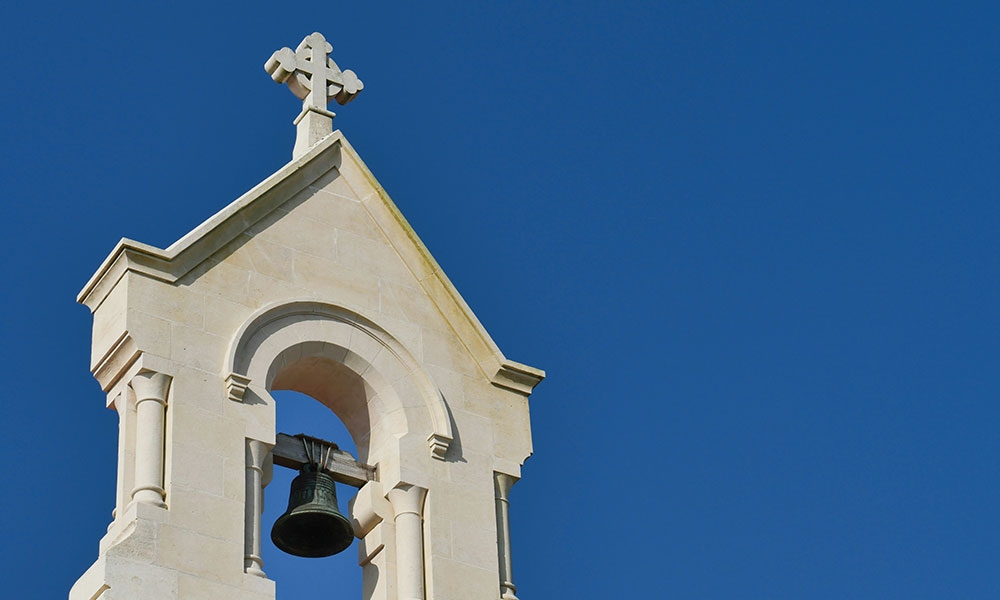
The use of bells began in the 400s when St. Paulinus, bishop of Nola, introduced them in order to summon his monks to prayer. “In the seventh century Pope Sabinianus approved the use of bells to call the faithful to the Mass. The Venerable Bede, an English saint of the eighth century, is credited with the introduction of bell of bell ringing at Requiem Masses. By the ninth century the use of bells had spread to even the small parish churches of the western Roman Empire” (“Sanctus Bells,” adoremus.org).
The bells pealing in a church’s tower or steeple informed towns and villages that the canon of the Mass would soon ring for the Sanctus prayer, allowing those unable to be present to reflect on the presence of the eucharistic Lord. In 1962, St. John XXIII promulgated a shortened version of the Latin Mass, but the ringing of bells ordered by the Council of Trent remained.
In 1963, the Second Vatican Council issued its first document, Sacrosanctum Concilium, the Constitution on the Sacred Liturgy. The council fathers allowed the opening Liturgy of the Word to be prayed in the vernacular while the canon of the Mass, now called the Eucharistic Prayer, would be prayed by the celebrant in Latin. Then, Pope (now St.) Paul VI allowed Mass to be celebrated completely in the vernacular, and bell-ringing became optional.
But let’s go back to a time before that to describe a phenomenon that used to take place. An altar server rang handbells at the Sanctus (Holy, Holy); and, as a signal, at the epiclesis, when the celebrant placed his hands over the host and chalice, praying that the Holy Spirit change them into Christ’s flesh and blood.
Two other servers genuflected, climbed the steps and knelt behind the priest on the predella. Following the celebrant’s pronouncing the words of consecration, the bells rang out as he genuflected in adoration. The bells rang again as he elevated the now sacred body of Christ for the congregation to worship and adore, the servers holding up the back of his chasuble. Again, the bells rang as, once more, the priest genuflected.
The same actions accompanied the consecration of the blood of Christ. After the joyful pealing of the bells, the priest made a final genuflection. The server thrice rang the bells a final time at the Domine non sum dignus (Lord, I am not worthy) recited three times before the priest consumed Communion. The great beauty in this form of the Mass was a feast for the senses and the soul.
We are human and need to engage our senses to respectful worship. The three years of the National Eucharistic Revival will not mean much if the Eucharist is not treated in an extraordinary manner. The “smells and bells” heighten reverential wonder as, with the joyful adoration of the bells, we experience Jesus Christ truly among us.
To conclude, we turn to G.K. Chesterton: “We do not really want a religion that is right where we are right. We want a religion that is right where we are wrong. We do not want … a Church that will move with the world. We want a church that will move the world.”